Adjective Games and How to Teach Adjectives in ESL Classes (Free Printable Pack)
October 27, 2026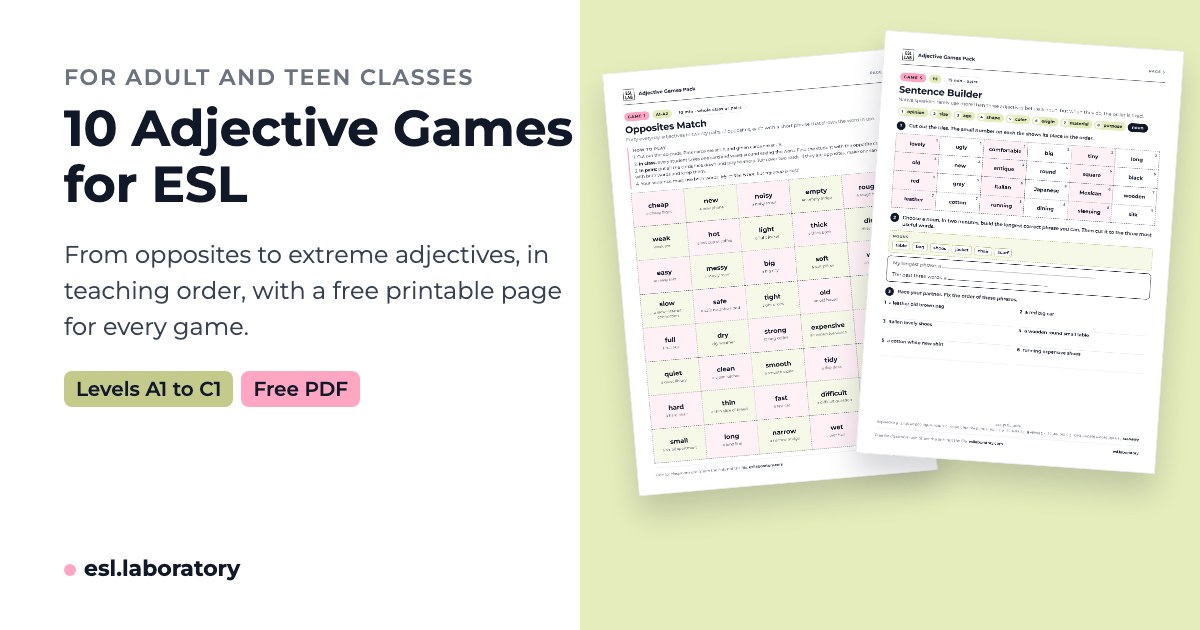
Table of Contents
- Teaching adjectives step by step
- Adjective games for beginners (A1 to A2)
- 1. Opposites Match
- 2. Mystery Bag
- Comparative adjectives games (A2 to B1)
- 3. Apartment Hunt
- 4. Ranking Debate
- Adjective order games and -ed and -ing (B1)
- 5. Sentence Builder
- 6. Bored or Boring?
- Adjective activities for intermediate students (B1 to B2)
- 7. Dating Profile
- 8. Product Review
- Advanced adjective games for C1 classes
- 9. Upgrade the Adjective
- 10. Style Swap
- Ready-to-teach lessons with adjectives
- Teaching adjectives FAQ
Here are ten adjective games for teens and adults, sorted by level from A1 to C1, plus a clear order for how to teach adjectives so each game comes at the right moment. Most take under five minutes to set up, and none of them need children's props. Every game has its own page in one free PDF, so your students can play in pairs while you listen.
If you are planning a whole course, start with the teaching sequence below. If you need adjective games for tomorrow's class, skip straight to your level. Every game names the mistake it fixes, so you can pick by what your students get wrong.
Teaching adjectives step by step
Teaching adjectives works best in a fixed order, because each step needs the one before it. A student who can't say "a big house" yet won't manage "a lovely big old house". Adjectives ESL students meet first are usually opposites, since pairs like hot and cold are easy to show and remember. Comparison comes next, then the order of adjectives, and strong adjectives come last.
| Level | Topic | Typical mistake | Games |
| A1 | Adjective before the noun, be + adjective | a car red, the reds cars | 1 and 2 |
| A2 | Comparatives and superlatives | more cheap, the most big | 3 and 4 |
| B1 | Order of adjectives | a leather old brown bag | 5 |
| B1 | -ed and -ing adjectives | I am boring (meaning bored) | 6 |
| B2 | Describing words for real tasks | nice and good for everything | 7 and 8 |
| C1 | Extreme adjectives and intensifiers | very enormous, absolutely good | 9 and 10 |
Don't teach all eight categories of adjective order at once. At B1, opinion, size, age and color cover most real sentences, and the rest can wait until students write longer descriptions. Whatever the stage, end with production. A gap-fill tells you that students recognize the right form, but only speaking or writing shows that they can use it. That is why each stage in the table is paired with a game rather than an exercise.
Run the game after the rule, then come back to it a week later as revision. Students remember a word they used to win a round far better than one they copied from the board. Our post on why games belong in ESL lessons explains the thinking behind this. If you want a full adjectives lesson plan rather than a game, the grammar section has ready lessons at each of these stages, and the best ones are linked under the games below.
The games at a glance
|
| Free · printable PDF · no sign-upAdjective Games PackTen pages, one for each game below, in the same order: opposite cards, mystery object cards, an apartment info gap, ranking lists, adjective order tiles, -ed and -ing situation cards, a dating profile, a product review, an upgrade paragraph and a style swap. Every page works for pairs or small groups without you reading anything aloud.10 games10 pagesA1 to C1A4 and LetterDownload the free PDFUS Letter: PDF |
Adjective games for beginners (A1 to A2)
These two games work from the first weeks of A1 and stay useful through A2. Each takes five to ten minutes, and both drill the adjective before the noun and after be.
1. Opposites Match
1of 10A1-A210 minVocabularyFree printable · page 1 How it works
Model sentencesMy coffee is hot, but my soup is cold.My bag is heavy, but my jacket is light.
|
Opposites for feelings The Feelings and Emotions Vocabulary worksheet (A2-B1) ends with six opposites, like angry and calm or confused and sure, so it works as the next step once the everyday pairs are easy. |
2. Mystery Bag
2of 10A1-A210 minSpeakingFree printable · page 2 How it works
What students sayIt's small, hard and cold.It's round and a little rough, but it isn't heavy.
|
When the word is missing Bits and Bobs (A1-A2) teaches the names of small everyday things and, more usefully, how to describe an object when you forget its name. Mystery Bag is a quick warm-up for it. |
Comparative adjectives games (A2 to B1)
Comparatives and superlatives need a lot of repetition, and these two comparative adjectives games keep it fast. The first one makes students ask, the second one makes them argue.
3. Apartment Hunt
3of 10A215 minComparativesFree printable · page 3 How it works
A sample exchangeAskIs yours cheaper than mine?AnswerYes, it is. Is yours bigger?DecideYours is bigger, but mine is closer to the center.
|
Teach the forms first Comparatives: Cities (A1-A2) uses real city facts and also teaches as...as and not as...as. The Comparatives and Superlatives worksheet (A1-A2) has a rule card and a task where students correct mistakes like more cheap and the most big. |
4. Ranking Debate
4of 10A2-B115 minSuperlativesFree printable · page 4 How it works
Write on the boardA pilot is more stressful than a chef.The fridge is the most useful.A chef isn't as stressful as a nurse.
|
Adjective order games and -ed and -ing (B1)
Teach the rule first. Adjectives before a noun usually come in this order: opinion, size, age, shape, color, origin, material and purpose, as in running shoes. Then let students build phrases with their hands, which is faster than any explanation.
5. Sentence Builder
5of 10B115 minWord orderFree printable · page 5 How it works
Long and shortToo longa lovely tiny antique square black Japanese silk scarfNaturala lovely black silk scarf
|
The lesson behind the tiles Sell it! (A1-A2) teaches adjective order through furniture ads: students sort words like vintage, narrow and marble by type, then write their own ad. Sentence Builder is the game to play the following week. |
6. Bored or Boring?
6of 10B115 min-ed and -ingFree printable · page 6 How it works
One roundThe cardYour flight is canceled for the second time.The answerIt was frustrating. I was frustrated.
|
Where the words come from Movies (A2-B1) teaches the -ing side with words like predictable, depressing and moving, so students can say why a film made them feel that way. For A1-A2, How Do You Feel? teaches the -ed side: bored, embarrassed, stressed and excited. |
Adjective activities for intermediate students (B1 to B2)
At B1-B2, adjective activities should push students past nice and interesting. Each of these two forces a choice between words, which is where progress happens.
7. Dating Profile
7of 10B1-B220 minPersonalityFree printable · page 7 How it works
A model lineAmbitious, well-dressed and a little dramatic. Looking for a partner who is patient and good at keeping secrets.
|
Lessons for describing people Freckles, Curls, and More (B1-B2) is free and teaches precise words for appearance. Beat the Impostor Syndrome (B1-B2) works with professional adjectives like reliable, resourceful and meticulous. |
8. Product Review
8of 10B1-B220 minWritingFree printable · page 8 How it works
Words shoppers really usedurableflimsyoverpricedlightweightbulky
|
Reviews in real life Deinfluencing (A2-B1) is about influencers who tell the truth about popular products, a perfect follow-up to the review round. How Was Your Stay? (A1-A2) teaches positive and negative hotel reviews for lower levels. |
Advanced adjective games for C1 classes
C1 students know the grammar. What they need now is range, the difference between a big problem and a serious, major or overwhelming one. Both games below build that range through writing first, so students have time to choose, and then through speaking.
9. Upgrade the Adjective
9of 10B2-C115 minExtreme adjectivesFree printable · page 9 How it works
The ruleCorrectabsolutely enormousWrongvery enormous
|
Strong words for feelings Beyond Happy and Sad (B1-B2) teaches twelve precise emotions, from relieved to devastated, and asks students to order them from mild to strong. It is the vocabulary that game 9 upgrades to. |
10. Style Swap
10of 10C120 minWritingFree printable · page 10 How it works
Same room, two attitudesThe ada classic, peaceful room with a cozy balconyThe reviewa dated, dull room with a tiny balcony
|
Take the writing further Coherence for Reviews (B2-C1) teaches how to organize a restaurant, book or hotel review so it reads well. Unusual Hotels (A2-B1) gives lower levels hotels where guests stay next to giraffes, monkeys or deer, and a short blog post to read. |
Adjective Games PackPages 1 to 10 hold the printables for games 1 to 10, in the order of this post.Download the free PDF |
Ready-to-teach lessons with adjectives
Games recycle adjectives, and lessons give them a context. Adjective games work best once students have met the words in a real text, and these lessons provide that text. Each one comes with a Teacher's Version and a Quizlet set. For more games, try our printable speaking games and present simple games, which use the same short rounds and visible scoring.
| Level | Lesson | Goes with |
| A1-A2 | Comparatives and Superlatives | Game 3, worksheet |
| A1-A2 | Comparatives: Cities | Game 3 |
| A1-A2 | Bits And Bobs | Game 2 |
| A1-A2 | Sell it! | Game 5 |
| A1-A2 | How Do You Feel? | Game 6 |
| A1-A2 | Personality Types | Game 7 |
| A2-B1 | Feelings and Emotions Vocabulary | Game 1, worksheet |
| A2-B1 | Movies | Game 6 |
| A2-B1 | Describing People | Game 7, worksheet |
| A2-B1 | Deinfluencing | Game 8 |
| B1-B2 | Freckles, Curls, and More | Game 7, free |
| B1-B2 | Beyond Happy and Sad | Game 9, worksheet |
| B2-C1 | Coherence for reviews | Game 10 |
Standard gives you the lesson PDFs and a Quizlet set for every lesson, Plus adds homework, and Pro adds Miro boards, interactive homework and games. Compare plans.
Teaching adjectives FAQ
In what order should I teach adjectives?
Start with common opposites and be + adjective, then comparatives and superlatives at A2, adjective order and -ed and -ing adjectives at B1, and extreme adjectives and intensifiers at B2-C1. The table at the top of this article matches each stage to a game.
How do I explain -ed and -ing adjectives?
Use one rule. The -ed form describes how you feel, and the -ing form describes what causes the feeling: "The movie was boring, so I was bored." These are the adjectives ESL students mix up most. Game 6 practices exactly this.
How many new adjectives should I teach in one lesson?
Eight to twelve. With more, students recognize the words but can't use them. Bring them back in a game the following week.
How can I check that students have learned them?
Ask for production, not recognition. Show a photo and give students two minutes to write five sentences about it. If they use the new adjectives without looking at their notes, they know them.
Do I need to sign up to download the PDF?
No. The Adjective Games Pack is a direct download, in A4 and US Letter.