Adult students don't need a reason to play. They need a reason to keep talking after the first answer. A good speaking game gives them one: a board that decides whose turn it is, a timer that won't let them stop, a partner who must ask a follow-up question. The game runs the conversation, so you can step back and listen.
Here are six ESL speaking games for adults that you can print and play tomorrow, from a conversation board game for A2 classes to a fluency drill for C1. All six are in one free PDF, game 1 on page 1 and so on, with the rules printed on every page.
The games at a glance | # | Game | Level | Time | | 1 | The Conversation Board Game | A2-B1 | 20 min | | 2 | Roll Two Dice | B1-B2 | 15-25 min | | 3 | Speaking Tic-Tac-Toe | A2-C1 | 10 min | | 4 | Speaking Battleships | A2-B1 | 15 min | | 5 | Sneak It In | B1-C1 | 15 min | | 6 | 4-3-2 Fluency Rounds | B1-C1 | 20 min |
|
| Free · printable PDFSpeaking Games for AdultsAll six games below, one page each and numbered like this post: a conversation board, a two-dice topic grid, three tic-tac-toe grids, a battleships sheet, 18 secret phrase cards and the 4-3-2 story cards. The rules are printed on every page, so students can play without you.6 games6 pagesA2 to C1A4 and LetterDownload the free PDFUS Letter: PDF |
What makes a speaking game work with adults
- The talk is the move. In every game here, you can't move, claim a square or score until you have said something. A game where students only say a word or tick a box is a vocabulary game, not a speaking game.
- A rule forces the second sentence. Most adult students stop after one answer. A follow-up question, a 30-second timer or a hidden phrase keeps them going.
- The topics are grown-up. Work, money, travel and the last series they watched. Nothing about favorite colors.
- The rules are on the page. Groups can start without you explaining anything twice, which also makes the games easy to use as a fast finisher or a cover lesson.
Looking for Two Truths and a Lie or Would You Rather? They're in our 15 back-to-school icebreakers. Taboo-style games, Just a Minute and Hot Seat are in 8 ESL vocabulary games for adults online, and ready-made role-play cards are in ESL role play scenarios for adults. The six games below are the ones you print and put on the table.
6 printable ESL speaking games for adults
Games 1 to 3 work from A2 and need only a die or a pen. Games 4 and 5 practice specific language. Game 6 is a fluency drill for stronger groups.
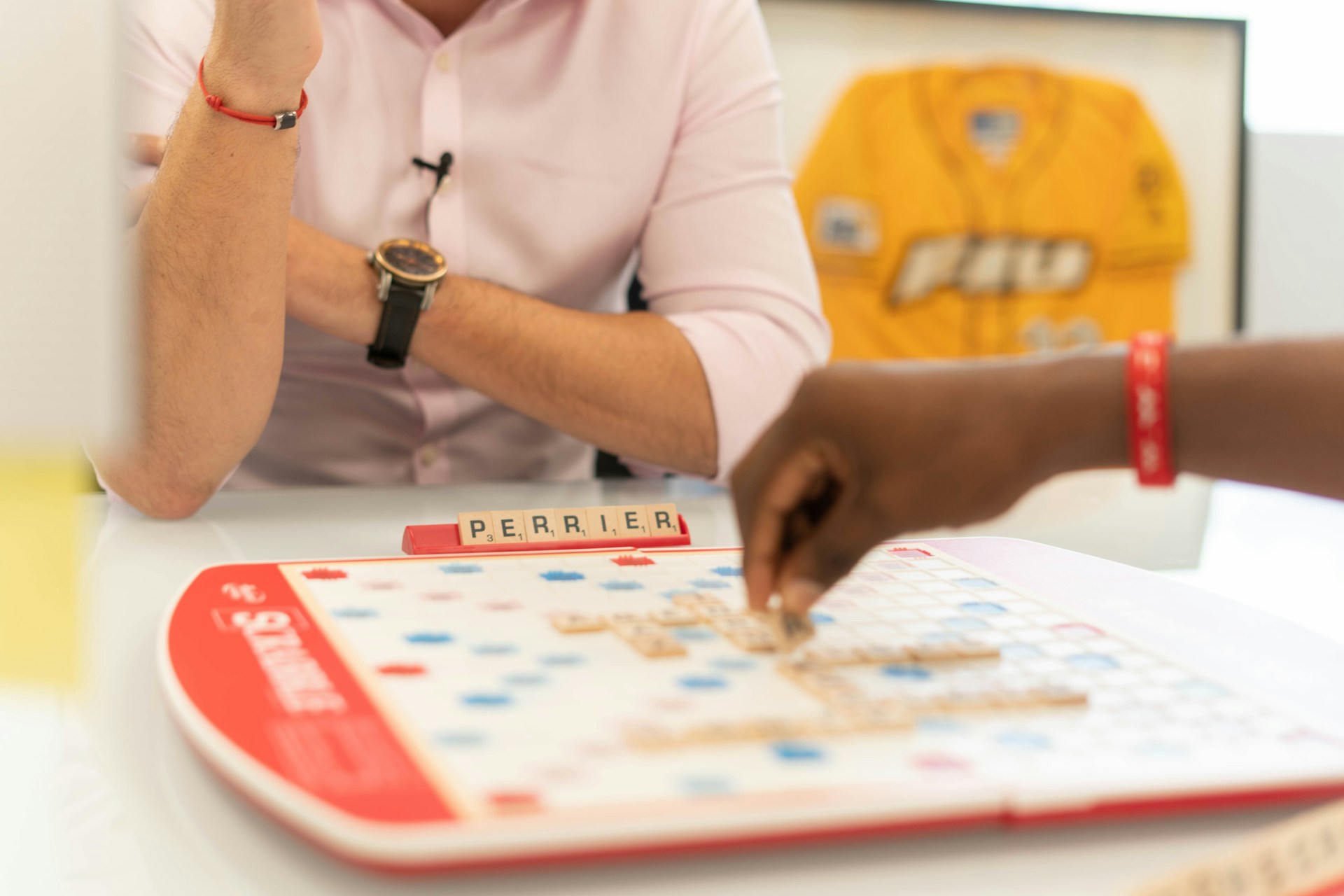
1of 6A2-B120 min2-4 playersFree printable · page 1 The Conversation Board Game How to play- Players put a coin on START, roll the die and move.
- They answer the question on their square in at least two sentences.
- The follow-up rule: the player on their left asks one follow-up question, and the next player rolls only after the answer.
- Special squares say go back 2, talk for 30 seconds or ask any player a question. The first player to reach FINISH wins.
| From the printableSquare 13What can you cook really well?Follow-upWho did you learn it from? |
| Why it works The board does the turn-taking, and the follow-up rule doubles the talk on every square. Six follow-up questions are printed under the board, so lower levels have something to say when they are stuck. If your students stop after one answer outside the game too, The Art of Small Talk is an A2-B1 lesson on keeping a conversation going with follow-up questions. |
Online: Share the PDF page on your screen and use a dice roller in the browser. Students tell you where to move their counter. In a one-to-one lesson, you play too. | Free printable · page 1A 30-square board with 25 everyday questions, special squares and follow-up questions.Download the free PDFUS Letter: PDF |
|
2of 6B1-B215-25 minPairs or groups of 3Free printable · page 2 Roll Two Dice How to play- Students roll two dice. The first die picks the row, the topic: work, food, travel, money, technology or people.
- The second die picks the column, the task: tell a story, compare, give advice, give an opinion, predict or describe.
- They talk for one minute on that square while their partner times them, then the partner asks one question and rolls.
- If a square is already used, they roll the second die again.
| From the printableRoll 4 and 2Money: compare paying by card and paying in cashRoll 5 and 5Technology: what will your phone do in ten years? |
| Why it works One page holds 36 different speaking tasks, and the dice choose for the students, so nobody spends five minutes picking an easy topic. Each column also needs different grammar: past tenses for stories, comparatives, should for advice, will for predictions. The phrases for each column are printed under the grid. For more practice with the predict column, Life in 2030 is a free A2-B1 lesson on predictions with will and won't. |
Online: Any free online dice roller works. Paste the grid into your whiteboard and cross out used squares as you go. | Free printable · page 2The 6x6 grid of topics and tasks, plus phrases for each kind of task.Download the free PDFUS Letter: PDF |
|
3of 6A2-C110 min a grid2 players or 2 teamsFree printable · page 3 Speaking Tic-Tac-Toe How to play- Students choose the grid for their level: A2-B1, B1-B2 or B2-C1.
- Player X picks a square and talks about the topic for 30 seconds without stopping. Player O times on a phone.
- A pause of more than three seconds, or a word in their own language, and the square stays empty.
- If they make it, they draw their X or O. Three in a row wins.
| From the printableA2-B1A good neighborB1-B2Money and happinessB2-C1Lying to be polite |
| Why it works Every square is a small fluency challenge, and students have to plan: the corner they need might be the topic they find hardest. Three grids on one page make it work in a mixed-level class. When a listener doesn't understand, they can stop the clock with a clarifying question, the skill taught in Come Again?, an A2-B1 lesson on phrases like Sorry, I didn't catch that. |
Online: Draw a 3x3 grid on the whiteboard and let students type X or O into the squares. You keep the time. | Free printable · page 3Three tic-tac-toe grids for three levels and phrases to keep talking.Download the free PDFUS Letter: PDF |
|
4of 6A2-B115 minPairsFree printable · page 4 Speaking Battleships How to play- Each student secretly ticks six things they have really done on a grid of 25 experiences.
- They take turns to ask about a square: Have you ever slept in a tent?
- Yes, I have is a hit, and the asker must ask a past simple question about it: When did you do that? Where were you?
- The first player to find all six of their partner's experiences wins.
| From the printableQuestionHave you ever missed a flight or a train?After a hitWhere were you going? |
Online: Students keep the grid on paper or in a document and play over video. The game needs no screen sharing at all. | Free printable · page 4A 5x5 grid of experiences, a grid to track your partner's answers and a grammar box.Download the free PDFUS Letter: PDF |
|
5of 6B1-C115 minGroups of 3-6Free printable · page 5 Sneak It In How to play- Each player takes three secret phrase cards: to be honest, out of the blue, it slipped my mind.
- The group picks a topic and talks for five minutes. Every player tries to use their phrases so naturally that nobody notices.
- Any player can say Sneaky! when they think they heard a secret phrase. A right guess wins the card, a wrong guess loses a point.
- Each phrase nobody catches scores a point for the player who used it.
| From the printableCardit slipped my mindMeansI forgotExampleI wanted to call you, but it slipped my mind. |
| Why it works Students usually learn phrases like these and never say them. This game makes them plan a sentence around each phrase, and everyone else listens closely to catch them. It works with any set of phrases: write your own cards for the language of your last lesson. For a set of workplace phrases, Phrasal Verbs for Work is a free B1-B2 lesson with touch base on, look into and sign off. |
Online: Send each student their three phrases in a private chat message before the discussion starts. | Free printable · page 518 secret phrase cards with meanings and examples, plus five topics.Download the free PDFUS Letter: PDF |
|
6of 6B1-C120 minGroups of 4Free printable · page 6 4-3-2 Fluency Rounds How to play- Each student takes a story card, such as A time you got lost, and writes up to ten key words. No full sentences.
- They tell the story to a partner in four minutes, then to a new partner in three minutes, then to a third partner in two minutes.
- Listeners ask one question at the end and don't help the speaker find words.
- After round 3, students answer three questions on the sheet about what they dropped and what got faster.
| From the printableRound 14 minutesRound 23 minutesRound 32 minutes |
| Why it works 4-3-2 is a fluency technique teachers have used since the 1980s. Students repeat the same story with less time, so the third telling is faster and smoother, and they feel the difference. It is the one game here with no winner, which suits classes that are tired of competing. For a full lesson built on storytelling at this level, Worst Dates Ever is a B2-C1 lesson on dating disasters that practices switching between present and past tenses. |
Online: Use breakout rooms of two and move students between them after each round. You set the timer for everyone. | Free printable · page 6Eight story cards, a round tracker, a notes box and three questions for after round 3.Download the free PDFUS Letter: PDF |
|
Speaking Games for AdultsAll six games in one free PDF, one page each, in the order of this post.Download the free PDF |
How to get more English out of any game
- Teach the game language first. Two minutes on It's your turn, Roll the die, Go back two, Who's next? stops students from switching into their own language between turns.
- Don't correct during the game. Walk around with a notepad, write down five mistakes you hear, and spend the last five minutes on them. The table below has the ones you will hear most.
- Play the same game twice. The second time, students already know the rules and spend all their attention on the language. Change the grid or the cards, keep the game.
- Start with a warm-up. If a group is quiet, a two-minute warmer from 10 creative ESL warm-up activities gets them talking before the board comes out.
Mistakes your students will make
Teacher's reference Slips to listen for while they play | Students say | Better | Why | | Is your turn. | It's your turn. | English sentences need a subject, even a short one. | | Roll the dices. | Roll the dice. / Roll the die. | One die, two dice. There is no dices. | | Have you ever went to a concert? | Have you ever been to a concert? | Ever + past participle: been, eaten, seen. | | When have you lost your keys? | When did you lose your keys? | A question with when asks about finished time: past simple. | | I am agree. | I agree. | Agree is a verb, so no am. | | It depends of the price. | It depends on the price. | Depend takes on. |
|
For more past simple practice after Battleships, 10 past simple speaking activities has games for every level, and 10 back-to-school speaking activities has debates and opinion games for a class that is ready for more.
Lessons to go with the games