Describing People ESL Lesson With Vocabulary and Activities (Free PDF)
October 27, 2026
Table of Contents
- Describing Appearance
- Adjective Order When Describing Appearance
- Personality Adjectives for ESL Students
- Useful Phrases for Describing People
- Describing People Lesson Plan
- Speaking Activities and Games
- 1. Three-Card Personality Puzzle
- 2. Police Sketch Artist
- 3. Describe Your Role Model
- 4. Dating Profile
- 5. Find a Classmate Who
- 6. Guess Who
- Describing People Worksheet
- Ready-Made Lessons on Personality and Appearance
- Describing People FAQ
This describing people ESL lesson runs 60 minutes and takes students from A1 to B2 through appearance, personality and the phrases that hold a description together. You get vocabulary tables, a timed lesson plan, six speaking activities and a free printable pack for five of them. It also covers the question students ask most, which is how to describe a person without sounding rude. The examples describe invented people, and none of the activities in this post uses photos of real people. Take the whole plan or just the tables. Each section works on its own, so you can teach only the part your level needs.
The speaking activities at a glance
|
| Free · printable PDF · no sign-upDescribing People Speaking PackFive pages, one for each of activities 1 to 5 below, in the same order. Every page works in pairs without you reading anything aloud. Activity 6 needs no printing.Page 1Three-Card Personality Puzzle30 cut-out adjective cards in three colors and the softening phrasesPage 2Police Sketch ArtistSix invented faces and empty frames, cut in half for Student A and Student BPage 3Describe Your Role ModelA one-minute note table, the model answer and phrase boxesPage 4Dating ProfileTom's sample profile, two blank profile cards and a matching tablePage 5Find a Classmate WhoA grid of twelve prompts with space for names and detailsDownload the free PDFUS Letter: PDF |
Describing Appearance
A good appearance description moves from general to specific. Height and build come first, then age, hair, face and anything that makes the person easy to recognize. Teach appearance adjectives in these groups, and students will remember where each word belongs.
| Category | Words | Example sentence |
| Height and build | tall, short, medium height, slim, petite, well-built, muscular, stocky | She's tall and slim. |
| Age | young, middle-aged, elderly, in his twenties, in her late forties | He's in his early thirties. |
| Hair | long, short, shoulder-length, straight, wavy, curly, blond, dark, red, gray, bald, a ponytail | She has long, curly dark hair. |
| Face | round, oval, freckles, dimples, high cheekbones, a beard, a mustache, clean-shaven | He has a round face and a short beard. |
| Eyes | blue, brown, green, hazel, big, almond-shaped, glasses | She has big brown eyes and wears glasses. |
| Special features | a scar, a tattoo, a birthmark, a nose ring, braces | He has a small tattoo on his wrist. |
| Clothes and style | casual, smart, sporty, stylish, always wears, dressed in | She's usually dressed in jeans and sneakers. |
Clothes are part of physical appearance for most students, so this is a natural link to a lesson on clothes and fashion. Fashion Tips (A2-B1) is free and has students describe outfits and give compliments, and our clothes and fashion discussion questions keep the talk going.
Words that need care Leave words that judge a body out of your lists. If students ask about weight, teach that heavy-set is the polite form, and that the most polite choice is usually not to comment on weight at all. Slim and petite are safe, while skinny can sound critical. |
Three mistakes come up in almost every class. Teach the split clearly. Use be for height, build and age, and use have for hair, eyes and features. In American English, has is more common than has got, so teach has first.
Be or have The three mistakes in almost every class
|
Adjective Order When Describing Appearance
When two or three adjectives come before hair, eyes or clothes, they follow a fixed order: opinion, size or length, age, shape, color, origin, material. So it's long curly black hair, never curly black long hair. In speech, most people use two adjectives at most, so don't push students to stack more. For games that practice this rule, see our article on adjective games.
| Write on the boardopinion, length, colorShe has lovely long dark hair.size, shape, colorHe has big round green eyes.opinion, age, materialHe's wearing a cool old leather jacket. |
Personality Adjectives for ESL Students
Personality adjectives are harder than appearance words because the same behavior can sound good or bad. Stubborn and determined describe the same person, but one criticizes and the other praises. Teach describing personality in three groups, then show the pairs that cross the line.
| Positive | Negative | Neutral |
| kind | rude | quiet |
| generous | selfish | talkative |
| honest | dishonest | reserved |
| patient | impatient | serious |
| reliable | lazy | ambitious |
| hard-working | bossy | competitive |
| easygoing | moody | shy |
| confident | arrogant | sensitive |
| cheerful | stubborn | cautious |
| determined | mean | introverted |
Point out the near pairs: determined and stubborn, confident and arrogant, careful with money and stingy, honest and blunt. Students learn more from one pair like this than from a long list of adjectives to describe people or twenty character traits. Positive and negative adjectives also depend on context, so ask students when being competitive helps and when it doesn't.
With A1-A2 classes, the Personality Types lesson introduces basic personality adjectives through a four-animal quiz. The personality section has more lessons up to C1, including one on introverts and one on workplace personality tests.
Native speakers rarely describe a flaw directly. They soften it with patterns like He can be a bit stubborn, She tends to be impatient in the mornings or He's not the most organized person. Teach these three patterns at B1, and students sound kinder and more natural at once. Praise works the other way, with stronger words, as in She's amazingly generous or He's one of the most reliable people I know. Activity 1 below turns the three columns and the softening patterns into a short puzzle.
Useful Phrases for Describing People
These sentence patterns are the core of how to describe a person in English. Teach each question together with its answer, because students need both.
| Pattern | What it's for | Example |
| What does she look like? | appearance | She's tall, with short gray hair. |
| What is he like? | personality | He's friendly and a bit shy. |
| She has + noun | features | She has blue eyes and freckles. |
| He is + adjective | height, build, age, character | He's tall. He's in his fifties. He's very patient. |
| He looks + adjective | an impression | He looks tired. She looks younger than she is. |
| She looks like + noun | a resemblance | She looks like her mother. |
| What does he like? | likes, a different question entirely | He likes jazz and long walks. |
Look like and be like cause most of the mistakes. Look like is about the outside: "What does your brother look like?" "He's tall and has curly hair." Be like is about the inside: "What's your brother like?" "He's funny and very generous." A quick test for students: if a photo could answer the question, it's look like.
Two smaller slips are worth correcting early. Students drop the article in She has a beard, and they mix looks and looks like in He looks like tired. The rule of thumb is short. Use looks with an adjective and looks like with a noun.
Describing People Lesson Plan
The easiest way to see how a describing people lesson plan works is to look at a real one. Freckles, Curls, and More is a 60-minute B1-B2 lesson from our library, and it is marked Free, so you can open the whole plan. It moves through four stages.
- Lead-in. Students answer one question: "How would you describe a person to a friend at a party?" In pairs, they describe people in photos without using names. This shows them at once which words they are missing.
- Vocabulary. Students meet precise words for faces and hair, such as pin-straight, fine hair, coily hair, spiral curls, dimples, a cleft chin and sun spots. They match the words to images and explain them to each other, so every word is used aloud at least once.
- Reading. Groups read about four invented characters, Emma, Marcus, Sofia and Kai, each with distinct features and lifestyles. Each group picks out the key details, then describes its character to the rest of the class from memory.
- Speaking. Groups take on everyday challenges, like describing a guest at a party or helping a friend spot a blind date in a busy restaurant. The task only works if the description is clear enough to pick the right person.
For homework, students complete a worksheet with collocations, gap-fill sentences and error correction. The lesson also comes with a Quizlet set, a Miro board and interactive homework. To build a lesson of your own on the same pattern, our guide to teaching vocabulary shows how word maps can carry the vocabulary stage. With A1 classes, spend the whole lesson on appearance and leave personality for the next one. With B2 classes, skip the basic table and go straight to the near pairs and the softening patterns.
The free lesson behind this plan Open it, print the student version and run it as it is. |
Speaking Activities and Games
Each activity below comes with a ready example you can read out or put on the board. Activities 1 to 5 each have a page in the free Describing People Speaking Pack, and activity 6 needs nothing at all.
1. Three-Card Personality Puzzle
1of 6A2-B115 minPersonalityFree printable · page 1 How it works
|
Softening a flaw is also the core skill in Pet Peeves (B1-B2), where students talk about the habits that annoy them, with an episode of the esl.laboratory podcast.
2. Police Sketch Artist
2of 6A2-B120 minAppearanceFree printable · page 2 How it works
|
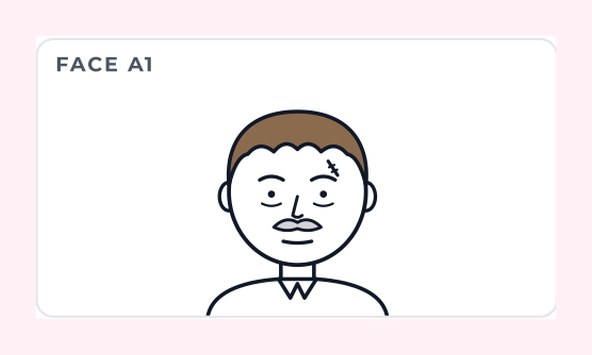
For B1-B2 classes that want more precise words than the word bank, stage 2 of Freckles, Curls, and More adds pin-straight, spiral curls, a cleft chin and sun spots.
3. Describe Your Role Model
3of 6B115 minFluencyFree printable · page 3 How it works
|
4. Dating Profile
4of 6A2-B120 minWriting and speakingFree printable · page 4 How it works
|
Where the matching leads First Impressions (A2-B1) has students watch strangers guess about each other, then make their own guesses about a partner with might, may and probably. |
5. Find a Classmate Who
5of 6A2-B115 minQuestionsFree printable · page 5 How it works
|
Where prompt 11 leads The Power of Introverts (B1-B2) follows an introvert's story and teaches the words for introverts and extroverts. |
6. Guess Who
6of 6A1-B110 minQuestionsNo printing How it works
|
Describing People Worksheet
The free pack above is for speaking. For written practice after the speaking stage, the library also has a describing people worksheet at A2-B1. It teaches 14 words for physical appearance, with a rule card on when to use is and when to use has. Students then work through three types of tasks. They choose is or has in short sentences, find the mistakes in a description of a picture, and solve a logic puzzle about five people at a family reunion. Students also complete a description of two grandparents from a word box. The answers are in the Teacher's Version. Use the sheet as homework after this lesson, or as a short class of its own for A2 students.
The written follow-up |
Describing People Speaking PackFive speaking pages for activities 1 to 5, in A4 and US Letter.Download the free PDF |
Ready-Made Lessons on Personality and Appearance
The library has full lessons on both halves of this topic. Three of them are marked Free, so you can try the format before you subscribe.
| Lesson | Level | What students do |
| London Street Style | A1-A2 | Learn clothes vocabulary from a street-style vlog and practice the present continuous |
| Personality Types | A1-A2 | Find their type in a four-animal personality quiz and learn adverbs of manner |
| Describing People | A2-B1 | A worksheet on 14 appearance words, is versus has and a logic puzzle |
| Fashion Tips (Free) | A2-B1 | Describe outfits, give compliments and use zero and first conditionals |
| First Impressions | A2-B1 | Watch strangers guess about each other, then make guesses about a partner with might, may and probably |
| Spooky Costume (Free) | A2-B1 | Discuss what a Halloween costume says about personality and learn new character words |
| Do You Have A Tattoo? | A2-B1 | Learn tattoo vocabulary from a video and share opinions |
| Makeup Essentials | A2-B1 | Follow a makeup routine and use collocations like apply foundation |
| Freckles, Curls, and More (Free) | B1-B2 | Describe faces and hairstyles in detail, as in the lesson plan above |
| Pet Peeves | B1-B2 | Talk about habits that annoy them, with an episode of the esl.laboratory podcast |
| The Power of Introverts | B1-B2 | Hear an introvert's story and learn words for introverts and extroverts |
| Personality Tests | B1-B2 | Compare CliftonStrengths and MBTI and discuss what workplace tests can show |
| Perfectionism | B2-C1 | Read an article on the perfectionist trap and discuss its pros and cons |
Standard gives you the lesson PDFs and a Quizlet set for every lesson, Plus adds homework, and Pro adds Miro boards, interactive homework and games. Compare plans.
Describing People FAQ
What level should students be to start describing people?
Start at A1 with be, have and a handful of words like tall, short, young and hair colors. Personality adjectives and look like versus be like fit A2-B1. Near pairs like stubborn and determined are B2 work.
How do I stop students from using offensive words?
Teach the polite options from the start and explain why they matter. Students usually want to be polite and simply don't know which words sound harsh in English.
What is the difference between look like and be like?
Look like asks about appearance, and be like asks about personality. "What does she look like?" gets "She's tall." "What's she like?" gets "She's kind."
How many new words should I teach in one lesson?
Twelve to fifteen. That is enough for a full description and few enough to use in the same class.
Do I need to sign up to download the PDF?
No. The Describing People Speaking Pack is a direct download, in A4 and US Letter.