18 Winter Idioms with Meanings and Examples (Free PDF)
October 25, 2026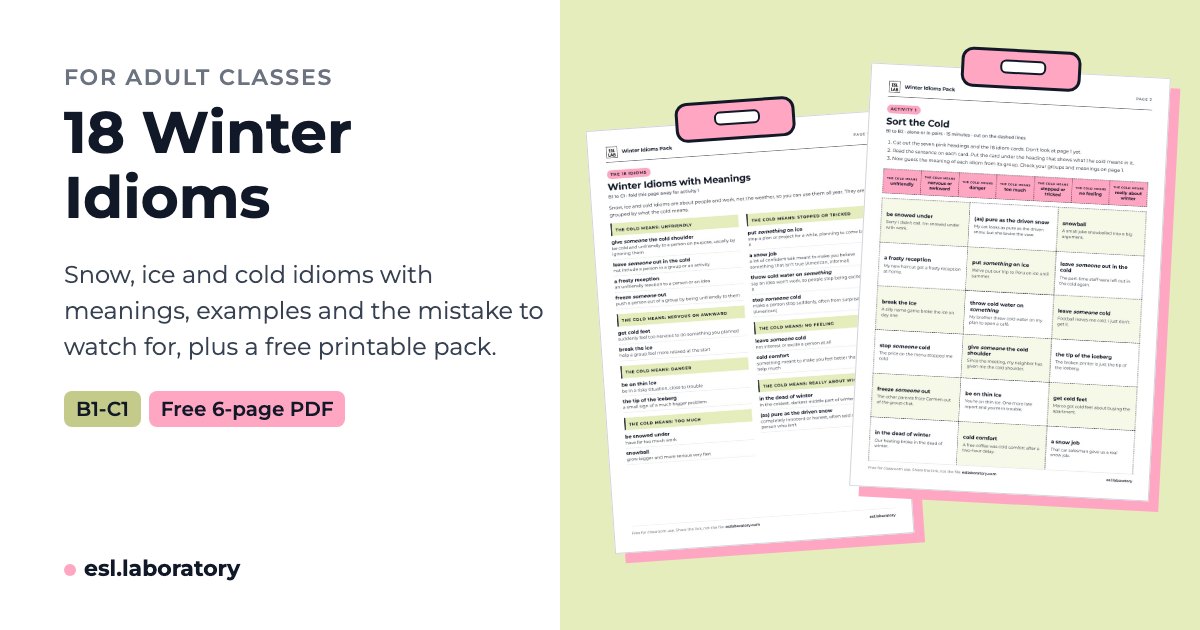
Table of Contents
- When the Cold Means Unfriendly
- Give someone the cold shoulder
- Leave someone out in the cold
- A frosty reception
- Freeze someone out
- When the Cold Means Nervous or Awkward
- Get cold feet
- Break the ice
- When the Ice Means Danger
- Be on thin ice
- The tip of the iceberg
- Idioms About Snow That Mean Too Much
- Be snowed under
- Snowball
- When the Cold Means Stopped or Tricked
- Put something on ice
- A snow job
- Throw cold water on something
- Stop someone cold
- When the Cold Means No Feeling
- Leave someone cold
- Cold comfort
- Two That Really Are About Winter
- In the dead of winter
- (as) pure as the driven snow
- Mistakes Your Students Will Make
- How to Teach Winter Idioms: 5 Activities
- More Idiom Lessons for Adults
- Winter Idioms FAQ
- What does "a snow job" mean?
- Are winter idioms only used in winter?
- Which winter idioms should B1 students learn first?
Here is a Monday in January, told in winter idioms:
"Leo came back from the break and was snowed under before ten. His idea for the spring campaign got a frosty reception, and by lunch his manager had put it on ice. He nearly got cold feet about his afternoon presentation. Then Carmen broke the ice with one question: Coffee?" |
Not one of those sentences is about the weather. That is the useful thing about winter idioms: they borrow snow, ice and cold to talk about work, people and feelings, so adults use them all year. Below are 18 winter idioms with meanings, an example from adult life and the mistake students make with each one. They are grouped by what the cold stands for, and five activities show you how to teach them.
Everything you need to print is in one free PDF, the Winter Idioms Pack: the 18 idioms on page 1, the printables for activities 1 to 4 on pages 2 to 5, and an answer key.
All 18 winter idioms at a glance
| ||||||||||||||||||||||||||||||||||||||||||||||||||
Free · printable PDF Winter Idioms Pack Every activity below that needs paper is in one PDF, numbered like this post. The instructions are printed on each page, so students can work alone or in pairs. Page 1The 18 idioms by group, with meaningsPage 2Activity 1 · Sort the Cold: 7 headings, 18 cut-out cardsPage 3Activity 2 · Leo's Week, Retold: the story in plain English, an idiom boxPage 4Activity 3 · Look-Alikes: six pairs, 12 sentencesPage 5Activity 4 · Cold Questions: 12 cut-out cardsPage 6Answer key for activities 1 to 3Download the free PDFUS Letter B1 to C1 · answer key included · direct download, no sign-up |
When the Cold Means Unfriendly
In these four, cold is the opposite of a warm welcome.
Give someone the cold shoulder
Meaning: Be cold and unfriendly to a person on purpose, usually by ignoring them.
"After I forgot her birthday, my coworker gave me the cold shoulder for a week."
Watch out: It's the cold shoulder, never a cold shoulder.
Leave someone out in the cold
Meaning: Not include a person in a group or an activity.
"The new schedule left the night shift out in the cold."
Watch out: It's often passive: I was left out in the cold. Nobody is outside.
A frosty reception
Meaning: An unfriendly reaction to a person or an idea.
"The plan got a frosty reception from the sales team."
Watch out: Frosty is the fixed word. Students say a frozen reception, which nobody uses.
Freeze someone out
Meaning: Push a person out of a group by being unfriendly to them.
"The old members froze out anybody with new ideas."
Watch out: The past forms are froze and frozen: She was frozen out of the decision.
When the Cold Means Nervous or Awkward
Here the cold is the stiff, uneasy feeling before something starts.
Get cold feet
Meaning: Suddenly feel too nervous to do something you planned.
"Two days before the job interview, Lucas got cold feet and almost canceled."
Watch out: Always plural, feet, and usually with about: get cold feet about the move.
Students may know it from weddings: it's one of the 25 idioms in our Valentine's Day idioms post. At work it's about interviews, moves and big decisions.
Break the ice
Meaning: Help a group feel more relaxed at the start.
"Our new manager broke the ice with a short quiz about the office."
Watch out: It's the moment the awkwardness ends, so it's good news. The activity is an icebreaker.
When the Ice Means Danger
Ice looks solid until it isn't. Both of these warn that something is worse than it seems.
Be on thin ice
Meaning: Be in a risky situation, close to trouble.
"After missing two deadlines, she knew she was on thin ice."
Watch out: On thin ice, not in thin ice. The longer form, skate on thin ice, sounds a little more dramatic.
The tip of the iceberg
Meaning: A small sign of a much bigger problem.
"The two resignations were the tip of the iceberg. The whole team was unhappy."
Watch out: It's almost always about problems. Used for good news, it sounds odd.
Idioms About Snow That Mean Too Much
Snow piles up. So does work, and so do problems.
Be snowed under
Meaning: Have far too much work.
"Our accountant is snowed under every April."
Watch out: It's passive and takes with: snowed under with emails. Never snowing under.
Snowball
Meaning: Grow bigger and more serious very fast.
"One late delivery snowballed into a lost customer."
Watch out: It's a verb here, usually with into. The noun phrase is a snowball effect.
When the Cold Means Stopped or Tricked
Four ways to stop a plan, a person or a conversation, one of them with nice words.
Put something on ice
Meaning: Stop a plan or project for a while, planning to come back to it.
"The company put the new website on ice until the fall sales were in."
Watch out: It's for plans and projects, not people. For the state, use be on ice: The website is on ice.
A snow job
Meaning: A lot of confident talk meant to make you believe something that isn't true (American, informal).
"The sales pitch was a snow job. Lots of numbers, and no answer to our question."
Watch out: Keep it for informal speech. In a report or an email to a client, say misleading.
This is the winter idiom people search for most. It's about deception, not snow and not a job.
Throw cold water on something
Meaning: Say an idea won't work, so people stop being excited about it.
"Finance threw cold water on our plan for a bigger party."
Watch out: Pour cold water on means the same. Both take on, not to.
Stop someone cold
Meaning: Make a person stop suddenly, often from surprise (American).
"The question about the budget stopped her cold."
Watch out: This is American English. British speakers more often say stop dead.
When the Cold Means No Feeling
Here the cold is a lack of feeling: no interest, no real comfort.
Leave someone cold
Meaning: Not interest or excite a person at all.
"Everybody loved the film, but it left me cold."
Watch out: The thing is the subject: The film left me cold, not I was cold about the film.
Cold comfort
Meaning: Something meant to make you feel better that doesn't help much.
"Knowing the whole team missed the target too was cold comfort."
Watch out: No article: it was cold comfort, not a cold comfort.
Two That Really Are About Winter
Out of 18 winter idioms, only these two keep the season in their meaning.
In the dead of winter
Meaning: In the coldest, darkest middle part of winter.
"Who plans a team-building hike in the dead of winter?"
Watch out: Dead means the deepest point here, as in the dead of night, not death.
(as) pure as the driven snow
Meaning: Completely innocent or honest, often said as a joke about a person who isn't.
"He likes to act pure as the driven snow, but he started the rumor."
Watch out: Listen for the irony. Said straight, it can sound old-fashioned.
Mistakes Your Students Will Make
Teacher's reference The forms students get wrong
|
How to Teach Winter Idioms: 5 Activities
The activities follow one idea: students learn the pattern before the list. Activity 1 sorts the idioms by what the cold means, activities 2 and 3 put them into sentences, activity 4 gets students talking about their own lives, and activity 5 closes with a short piece of writing. Activities 1 to 4 are in the free PDF.
The activities at a glance
|
1of 5B1-B215 minAlone or in pairsFree printable · page 2 Sort the Cold How it works
One-to-one: Your student sorts the cards and thinks aloud. Ask why there? for every card in the wrong group before you correct it. Online: Share page 2 on screen. Your students write each idiom under its heading in the chat or a shared document, then compare.
|
Winter lessons to go with the idioms Winter Idioms is the full worksheet for ten of these idioms, with an answer key. When Winter Gets Rough is a B1-B2 worksheet for the real winter words, from blizzard to frostbite. |
2of 5B1-B215-20 minAlone, then pairsFree printable · page 3 Leo's Week, Retold How it works
One-to-one: Do the Friday too, and swap. Your student finds the three idioms in your text. Online: Share page 3. Students type their ten answers in the chat at the same time, so nobody copies the first answer.
|
3of 5B1-C115 minAlone or in pairsFree printable · page 4 Look-Alikes How it works
One-to-one: Your student does the page alone, then explains each pair to you. Ask for a new sentence for every pair they got wrong. Online: Share page 4 and give each student one box. They read their sentences aloud and the group votes A or B.
|
4of 5B1-C115-20 minPairs or groups of 3Free printable · page 5 Cold Questions How it works
One-to-one: Take turns with the cards. Answer every second question yourself, so your student hears the idiom in a full answer first. Online: Read out the number of a card and the student answers. In groups, students pick a card number for the next person.
|
5of 5B1-C110 minAlone, then the groupNo printing The Office Forecast How it works
One-to-one: Write your own forecast first, then swap. Your student asks you about the worst day. Online: Students post their forecasts in the chat. Everybody reacts to the coldest one before you correct anything. |
For review games that work with any set of idioms, from bingo to dominoes, see our idiom games for adults.
More Idiom Lessons for Adults
Each season has its own set, and they all work the same way: idioms adults use at work and at home, in context, with an answer key.
Idiom worksheets for every season |
| Level | Lesson | Pairs well with |
| B1-B2 | Winter Idioms (worksheet) | Activity 1: ten of these idioms in a story |
| B1-B2 | When Winter Gets Rough (worksheet) | Winter vocabulary, not idioms |
| B1-B2 | Idioms About Autumn (worksheet) | The same idea for fall |
| B1-B2 | Halloween Idioms (worksheet) | Idioms about fear and surprise |
| B1-B2 | Valentine's Day Idioms (worksheet) | February: love and relationship idioms |
| B2-C1 | Feelings Idioms (worksheet) | Activity 4: talking about emotions |
Planning the first class back in January? See our first lesson after the winter holidays.
Winter Idioms FAQ
What does "a snow job" mean?
A snow job is a lot of confident talk meant to make you believe something that isn't true. It's informal American English.
Are winter idioms only used in winter?
No. Almost all of them are used all year, especially at work. Only in the dead of winter and pure as the driven snow keep the season in their meaning.
Which winter idioms should B1 students learn first?
Break the ice, be snowed under and get cold feet. Students hear them often, and each one has a clear situation they will recognize.