First Lesson After the Winter Holidays: 8 ESL Activities for Adults (Free PDF)

October 25, 2026
First Lesson After the Winter Holidays: 8 ESL Activities for Adults (Free PDF)

Table of Contents


The first lesson after the winter holidays has one job: get the English moving again. Your adult students have had two weeks without it. Some are tired, some are still on holiday in their heads, and "How was your holiday?" gets three words and a shrug.

These eight ESL activities after winter break are built for that first class in January. None of them assume your students celebrated, traveled or had a good time, and six never ask about the student's own break at all. Each one has a level, a time, a version for one-to-one and online lessons, and a lesson to go with it. Six are in one free PDF, activity 1 on page 1 and so on.

Coming back after a summer break or any other gap? Our 8 back-to-school speaking activities are for that. Meeting a brand-new group in January? Start with our 15 ESL icebreakers for adults.

The activities at a glance

#ActivityLevelTime
1Winter Break Conversation QuestionsA2-C115 min
2The Cozy Day RankingA1-A210 min
3January Weather ReportB1-B210-15 min
4First Day Back InboxB1-C120 min
5The Wheel of the YearB2-C115 min
6New Year Around the WorldB1-B215 min
7The January Opinion LineA2-C110 min
8Holiday Hangover AdviceB1-B215 min
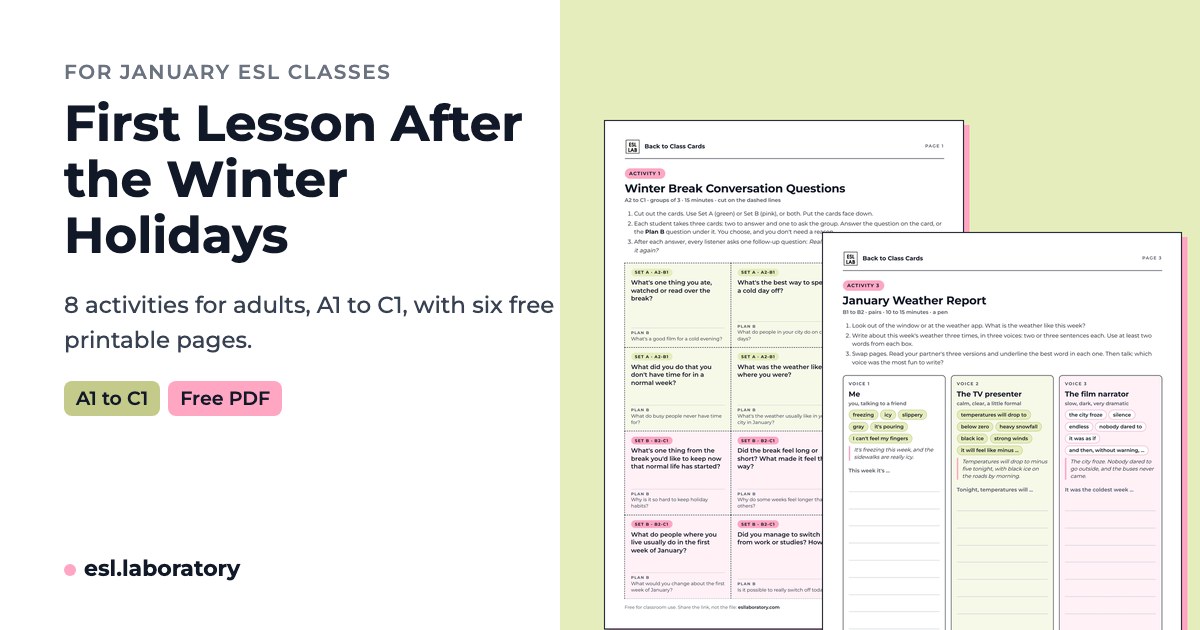
Free · printable PDFBack to Class CardsSix pages for activities 1 to 6, numbered like this post: 12 winter break question cards, the cozy day diamond, three weather voices, a first-day-back inbox, the wheel of the year and 16 New Year tradition cards. The rules are printed on every page, so groups can start without you.6 pagesA1 to C1Groups and one-to-oneA4 and LetterDownload the free PDFUS Letter: PDF. A direct download, with no sign-up.

Get them talking again

Start small. Activities 1 and 2 put students in groups of three or in pairs, with a task that has a clear end, so nobody has to perform for the whole class in the first ten minutes.

1of 8A2-C115 minGroups of 3Free printable · page 1

Winter Break Conversation Questions

How it works
  • Groups get one set of cards: Set A for A2-B1, Set B for B2-C1. Each card has a question and a Plan B question under it.
  • Each student takes three cards: two to answer and one to ask the group. They answer the main question or Plan B, and they don't need a reason.
  • After each answer, every listener asks one follow-up question, like What was it like? or Would you do it again?
From the printableSet AWhat's the best way to spend a cold day off?Plan BWhat do people in your city do on cold days?Set BDid the break feel long or short? What made it feel that way?
Why it works

Plan B is what makes these winter break conversation questions safe. A student who worked through the holidays, was ill or spent the break alone can answer What do people in your city do on cold days? instead, and nobody notices the switch. The Set A questions also show you who has lost their past simple over the break. If the -ed endings have gone, the free worksheet Past Simple Regular Verbs (A1-A2) brings back the spelling rules and did and didn't.

One-to-one: Put the cards face down between you and take turns, answering yours too. Your student hears a full answer with details before they give one.

Online: Share the page on screen and give each student two card numbers in a private chat message. They answer out loud, and the group asks the follow-ups.

Free printable · page 1✓12 question cards in two level sets✓A Plan B question on every card✓Follow-up questions in the rulesDownload the free PDF

For more on the cozy side of winter, Gluggavedur is a B2-C1 lesson on the Icelandic idea of window weather: weather that looks lovely from inside. For A1-A2 groups, Winter Wardrobe teaches winter clothes and ends with students designing a winter wardrobe for their teacher.

Lessons for winter talk

GluggavedurB2C1ProSee the Pro lesson →Winter WardrobeA1A2ProSee the Pro lesson →

2of 8A1-A210 minPairsFree printable · page 2

The Cozy Day Ranking

How it works
  • Pairs cut out nine cards with ways to spend a cold day off, like have a nap, make soup and go for a walk in the snow.
  • They put the cards on the diamond: their favorite at the top, their least favorite at the bottom.
  • They must agree on every card before they put it down, using the phrases on the page: I love ..., What about you?, Really? I don't.
From the printableCardread a book under a blanketCardhave breakfast in bedPhraseReally? I don't.
Why it works

Beginners can't tell a story about their break yet, but they can rank nine phrases and argue about soup. Agreeing is where the speaking happens: every card needs a short conversation before it goes down. The phrases come from My Lazy Vacation Day, an A1-A2 lesson with simple phrases like have a nap and have breakfast in bed, where students describe their ideal lazy day.

One-to-one: Make your own diamond first and keep it hidden. Your student makes theirs, then you compare and explain the biggest difference.

Online: Share the page on screen and type the nine phrases in the chat. Pairs agree on the order in breakout rooms and paste their top three back into the chat.

Free printable · page 2✓A ranking diamond with nine places✓Nine cut-out cozy day cards✓Phrases for agreeing and disagreeingDownload the free PDF

Bring back the words: an ESL lesson for January

Once students are talking, give the language a job. Activity 3 brings back winter vocabulary, and activity 4 brings back the English adult students need at work on their first day back.

3of 8B1-B210-15 minPairsFree printable · page 3

January Weather Report

How it works
  • Students look out of the window or at a weather app and describe this week's weather three times: as themselves, as a TV weather presenter and as the narrator of a dramatic film.
  • Each voice has its own word box on the page. Students use at least two words from each box, in two or three sentences.
  • They swap pages, underline the best word in each of their partner's versions, and talk about which voice was the most fun to write.
From the printableMeIt's freezing this week, and the sidewalks are really icy.TV presenterTemperatures will drop to minus five tonight.Film narratorThe city froze.
Why it works

Weather is the safest topic in January: everybody has some, and nobody has to talk about their holidays. Writing it three times makes students change register, from it's freezing to temperatures will drop to minus five to the city froze. When Winter Gets Rough is a B1-B2 worksheet for the presenter's words, like icy roads, blizzards and frost, and it makes good homework after this class. For B2-C1, Weather Forecast is a full lesson on forecast language.

One-to-one: Write the TV presenter version together, then let your student write the film narrator version alone. Read it back in your best film voice.

Online: Students type their dramatic film version in the chat without their name. The group guesses who wrote each one.

Free printable · page 3✓Three voices, each with a word box✓An example for every voice✓Sentence starters for A2 classesDownload the free PDF

For more weather games that need no printing, see our no-prep weather activities for adults. They were written for autumn, and most of them work just as well in January.

4of 8B1-C120 minPairsFree printable · page 4

First Day Back Inbox

How it works
  • It's the students' first morning back at work, and four short emails are waiting: a colleague moving a meeting, a client following up, a manager asking for January priorities and a team lunch invitation.
  • Each student takes two emails and writes a reply of two to four sentences, with at least one phrase from the box on the page.
  • They swap pages and check two things: did the reply answer the question, and is the tone right for the person?
From the printableEmail 2, a clientJust following up on the price list you promised before the holidays.PhraseSorry for the delay. You'll have it by Friday.
Why it works

Many adult students learn English for work, and their first day back is full of emails like these. The task is small and real, and every email asks a question, so the reply has a clear job. Email 2 is a client following up on a promise made before the holidays, which is the topic of Follow-up Email, a B1-B2 Business English lesson on writing polite, professional follow-up emails.

One-to-one: Your student writes the replies, and you answer each reply as the sender. A short email chain shows them how the tone changes.

Online: Paste one email at a time in the chat. Students write their replies in a shared document, then the group votes on the best one.

Free printable · page 4✓Four emails waiting after the break✓Phrases to start, answer and finish✓A peer check for toneDownload the free PDF

If your students like talking about work, our 30 work conversation questions keep the topic going for the rest of the week.

Close last year, open this one

January is the one time of year when everybody looks back and forward at once. Activity 5 does it with a student's own year, and activity 6 does it with the whole world, so nobody has to share more than they want to.

5of 8B2-C115 minPairsFree printable · page 5

The Wheel of the Year

How it works
  • Students shade six slices of a wheel for last year: work, people, health, learning, fun and home. The center is 1 and the edge is 10.
  • Each student chooses one slice to explain to their partner. Any slice: they never have to explain the low ones.
  • The partner asks two follow-up questions. At the end, each student writes one sentence about a slice they want to change this year.
From the printableSliceLearning: 8Looking backI'd give it an 8 because I finally finished my course.Follow-upWhat made it an 8, not a 10?
Why it works

The wheel gives a reflective task a shape. Students choose what to talk about, so a hard year stays private, and the language box (Looking back, ..., I didn't expect ...) pushes B2-C1 students past It was good. Year in Review is a B2-C1 lesson that starts with the same wheel, the Wheel of Life, and ends with each student writing a year-in-review post.

One-to-one: Shade your own wheel too and explain one slice first. Your student then chooses which of your slices to ask about, which makes the conversation two-way.

Online: Share a blank wheel on the whiteboard and let students shade their own copy on paper, out of the camera. Then pair them in breakout rooms.

Free printable · page 5✓A six-slice wheel from 1 to 10✓Language for looking back✓One slice for this yearDownload the free PDF

6of 8B1-B215 minGroups of 3Free printable · page 6

New Year Around the World

How it works
  • Groups cut out eight tradition cards and eight place cards, then match them: twelve grapes at midnight, a first visitor with a gift, a cake with a tiny figure inside.
  • They check the key at the bottom of the page, printed upside down.
  • Then they talk: Which tradition would you bring to your country? Which one would never work where you live?
From the printableTraditionAt midnight, people eat twelve grapes, one for each chime of the clock.TalkWhich tradition would you bring to your country?
Why it works

This one is about the world, not the student, so it works for every class. Students from Spain and Latin America often know Three Kings Day on January 6, and in many groups a student can explain a tradition the others have never heard of. New Year's Traditions is a B2-C1 lesson where students rank traditions from around the world. Lunar New Year falls on February 6 in 2027, so Chinese New Year, a B2-C1 listening lesson, fits a few weeks later.

One-to-one: Match the cards together, then ask your student to describe a New Year tradition from their family or city that isn't on the cards.

Online: Share the page on screen and let groups match in breakout rooms by writing pairs like A Japan in the chat. Show the key when everyone is back.

Free printable · page 6✓Eight tradition cards and eight place cards✓An upside-down answer key✓Three questions to talk aboutDownload the free PDF

Lessons for looking back and ahead

Year in ReviewB2C1ProSee the Pro lesson →New Year’s TraditionsB2C1ProSee the Pro lesson →

Two more with nothing to print

7of 8A2-C110 minThe whole groupNo printing

The January Opinion Line

How it works
  • Mark a line across the room: I agree at one end, I disagree at the other. Read one statement from the board.
  • Students stand on the line where they are. Two students from each end explain their place in one or two sentences.
  • Anyone may move after hearing the reasons, and the movers say what changed their mind. Then read the next statement.
Write on the boardStatementThe decorations should come down by January 6.StatementJanuary is the best month to start something new.StatementNew Year's resolutions are a waste of time.StatementJanuary feels longer than any other month.
Why it works

Students get up and move after two weeks on the sofa, and they give opinions instead of personal news. Every statement is about January in general, so it works in any class. If the resolutions statement gets the room going, New Year's Resolutions is a free A1-A2 lesson on the topic, and our New Year's resolutions conversation questions have 30 more for A2 to C1.

One-to-one: Read each statement and ask your student to give a number from 1 (disagree) to 5 (agree) and a reason. Then give your own number and disagree with them on purpose.

Online: Students type a number from 1 to 5 in the chat at the same time. Ask the highest and the lowest number to explain.

8of 8B1-B215 minGroups of 3No printing

Holiday Hangover Advice

How it works
  • Write this short letter to an advice column on the board.
  • Groups write a reply with three tips, using You could ..., Try ... and Why don't you ...?
  • Groups read their replies, and the class chooses the tip Sam should try first.
Write on the boardSam writesThe holidays are over and I can't get going. I'm back at work, but I'm tired, my inbox is full and I miss the slow mornings. How do people get back to normal?
Why it works

It's easier to give advice to Sam than to talk about your own flat January, but the tips students write are usually the ones they need. Holiday Hangover is the full B1-B2 lesson on that feeling: getting back to work after the holidays, with tips for the first days back and the vocabulary for post-holiday blues.

One-to-one: Ask your student to write Sam's letter about their own January, then write the reply together.

Online: Paste the letter in the chat. Each breakout room writes one reply in a shared document, and the class votes on the best tip.

For students who had a hard break

Not every student had a good holiday. Some worked the whole time, some were ill, and some spent it alone. Three small moves keep the first lesson after the winter holidays safe for them.

  • Let students choose. In activity 1, students pick which cards to answer, and every card has a Plan B question about people in general.
  • Ask about January, not the break. Activities 2, 3, 4, 6, 7 and 8 never ask about a student's own holidays.
  • Never ask why. If a student goes quiet, move them to a general question instead of asking what happened.

After this first class, the rest of the week is easier. Our Christmas conversation questions are for the last class before the break, and our 18 winter idioms work well later in January.

Mistakes students make in the first week of January

Teacher's reference

Slips to listen for after the winter break

Students sayBetterWhy
How was your holidays?How were your holidays? / How was your holiday?Holidays is plural, so it takes were.
Happy new year for you!Happy New Year to you!You wish it to a person, with to, not for.
I was in holidays.I was on holiday. / I was on vacation.On holiday, on vacation, on a break.
It's very cold today, no?It's really cold today, isn't it?English uses a tag question here.
I'm back to work since Monday.I've been back at work since Monday.Since + a starting point takes the present perfect.
The holidays were very relaxed.The holidays were very relaxing.Relaxing describes the holidays. Relaxed describes how you felt.

Lessons to go with the activities

LevelLessonPairs well with
A1-A2New Year's Resolutions (free)Activity 7: the resolutions statement
A1-A2Past Simple Regular Verbs (free worksheet)Activity 1: past simple after the break
A1-A2My Lazy Vacation DayActivity 2: cozy day phrases
A1-A2Winter WardrobeActivity 1: winter talk for beginners
B1-B2When Winter Gets Rough (worksheet)Activity 3: winter weather words
B1-B2Follow-up EmailActivity 4: replying to emails
B1-B2Holiday HangoverActivity 8: the first days back at work
B2-C1GluggavedurActivity 1: winter from inside
B2-C1Weather ForecastActivity 3: forecast language
B2-C1Year in ReviewActivity 5: the Wheel of Life
B2-C1New Year's TraditionsActivity 6: traditions around the world
B2-C1Chinese New YearActivity 6: Lunar New Year in February

First lesson back FAQ

What should I do in the first ESL lesson in January?

Restart the English before you teach anything new. One light speaking activity, like the cozy day ranking or the winter break questions, and one task that brings back language, like the weather report, make a good ESL lesson for January at any level.

How do I get adult students talking after the winter break?

Small groups first, a timer, and a task with a clear end. Whole-class speaking can wait until the second half of the lesson, when students have warmed up.

What if a student doesn't want to talk about their holiday?

Give every question a general version, like the Plan B questions in activity 1, and choose activities that are about January, not the break. Six of the eight activities in this post never ask about the student's own holidays.