Workplace Christmas English: Office Parties, Secret Santa and Holiday Emails
October 25, 2026
Table of Contents
- Replying to the Party Invitation
- Secret Santa
- Small Talk at the Office Party
- Giving a Short Toast
- Holiday Cards and Emails
- The Out-of-Office Reply
- Full Lessons for December at Work
- Workplace Christmas English FAQ
- Is "Merry Christmas" OK in a work email?
- How do I explain Secret Santa to students who have never done it?
- What if my students' company doesn't have a Christmas party?
Office Christmas party English is a small set of phrases that most coursebooks skip, and your working students need all of it in the same three weeks. They reply to an invitation, take part in a Secret Santa, make small talk with colleagues they barely know, maybe give a toast, write greetings to clients and set an out-of-office reply.
This post follows Lucas, who started in Finance in September, through six dates in his December. For each one you get the phrases that work, the register to choose, the mistakes your students are most likely to make and one activity you can run in 15 minutes. Everything is for B1 to C1 Business English classes, and five of the six activities are ready to print in the free pack below.
In many countries the office party is a New Year party rather than a Christmas one. Wherever this post says Christmas party, the same English works for any end-of-year event.
Lucas's December at a glance
|
Free · printable PDF · 7 pagesWorkplace Christmas English PackEverything you need to print for this post, one page per activity, in the same order.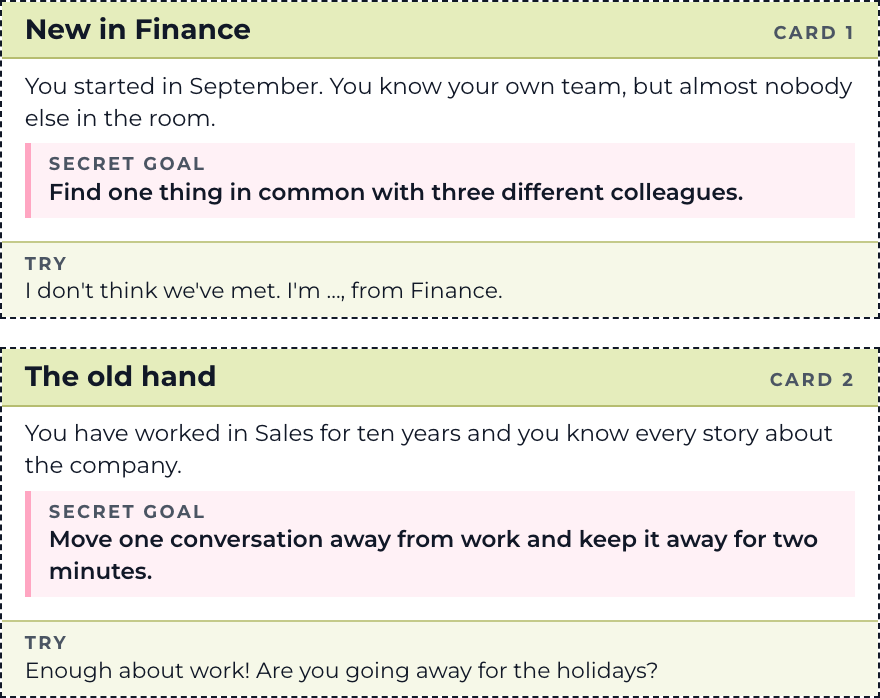 Page 4: two of the eight party role cards, each with a secret goal.
|
Replying to the Party Invitation
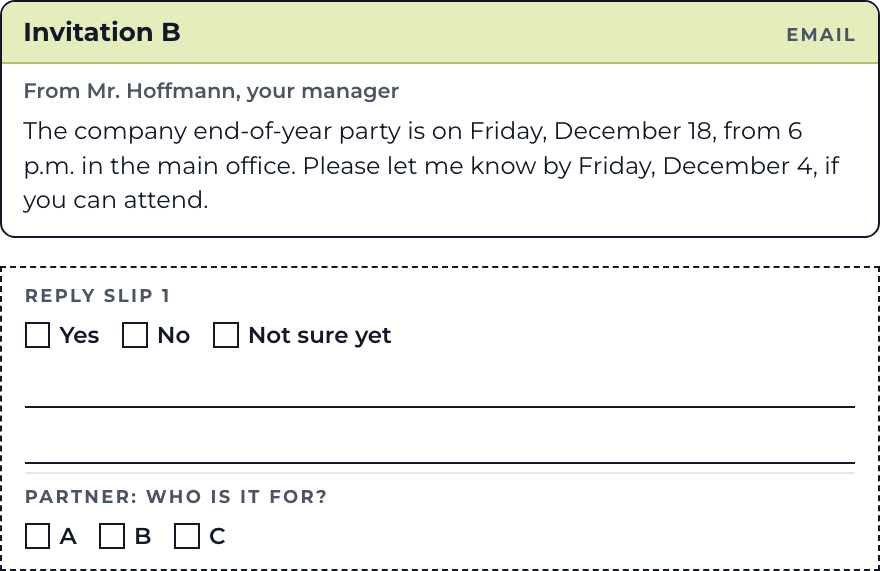
Tuesday, December 1. Mr. Hoffmann's email arrives: the company party is on December 18, and he needs an answer by Friday. Lucas has three invitations this week, and each one needs a different reply.
The reply is short, but the whole team often sees it, so register matters more than students expect.
| To colleagues | To a manager or client | |
| Yes | Count me in! | Thank you, I'd love to come. |
| No | Sorry, I can't make it this year. | I'm afraid I can't make it this year, but thank you for the invitation. |
| Not sure yet | Can I let you know by Friday? | Could I confirm by Friday, if that's all right? |
For your notes Mistakes to listen for
| ||||||||||||||
1of 6B1-B215 minFree printable · page 2 Who Is It For? Three invitations, three replies, and a partner who guesses the reader How it works
|
Secret Santa
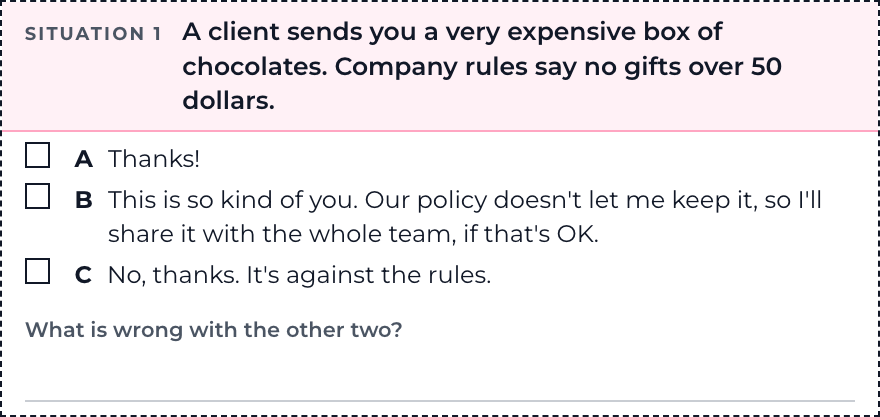
Friday, December 4. The team draws names for Secret Santa. Lucas has never done one, and the suggested price limit looks high to him.
Many students have never taken part in a Secret Santa, so start by explaining it. Every person in the team draws one colleague's name in secret and buys a gift for that colleague only. The team agrees on a price limit, and the giver stays secret until the gifts are opened.
Phrases for each job Suggesting a limitCould we go a bit lower, say 25? Then nobody has to worry about it. Thanking for a gift you don't loveThat's so thoughtful, thank you. Declining a gift that's too generousThis is really kind, but I'm afraid I can't accept it. |
For your notes Mistakes to listen for
| ||||||||||||||
2of 6B1-C115 minFree printable · page 3 The Diplomatic Reply Three gift situations, three replies each: which one keeps everybody happy? How it works
|
For a full hour on gifts at work, The Office Gift Dilemma (B2-C1) starts from Secret Santa and client gifts, then teaches students to decline, question or suggest an alternative in diplomatic language. For B1-B2 groups, Is It OK to Regift? turns the same awkward gift into a discussion, with words for presents and the passive voice.
Small Talk at the Office Party
Friday, December 18. The party. Lucas knows his own team and almost nobody else in the room.
Small talk is the biggest part of office Christmas party English, and it has three jobs: start the conversation, keep it going, and leave it politely. Each has its own phrases.
Phrases for each job StartingI don't think we've met. I'm Lucas, from Finance. StartingHow long have you been on the team? Keeping it goingWhat about you? Keeping it goingHow did you end up in marketing? LeavingI'm afraid I need to head off. LeavingIt was great to finally meet you. I'll let you get back to the party. |
Safe topics are the evening itself, holiday plans, food, films and how people came to their job. Topics to avoid are salaries, politics, a colleague who isn't there and, after a while, work itself. Talking only about work at the party is called shop talk, and moving away from it is a skill in itself.
For your notes Mistakes to listen for
| ||||||||||||||||||
3of 6B1-C120 minFree printable · page 4 The Party Mingle Eight role cards, eight secret goals, ten minutes of party How it works
|
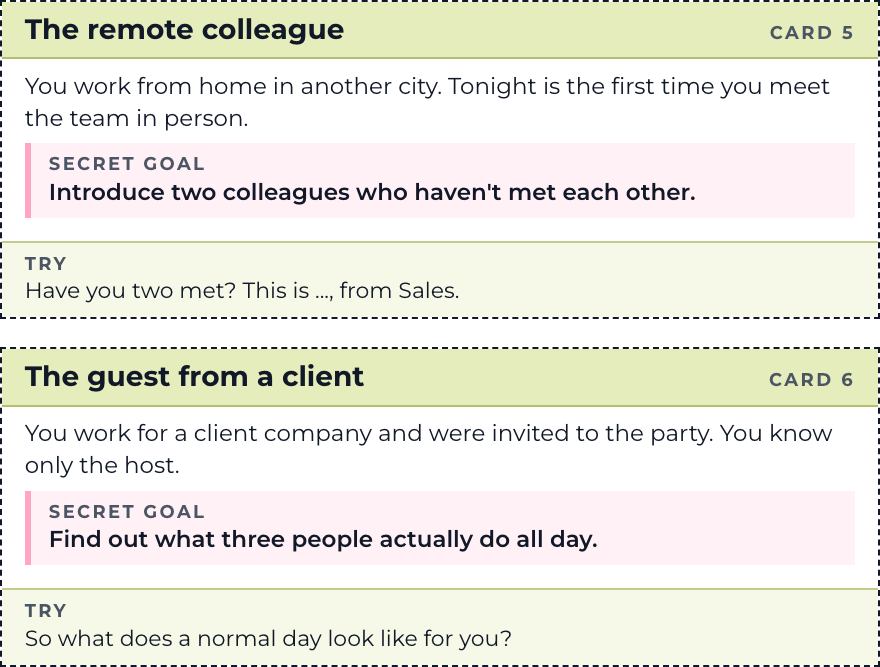
For the full lesson behind the mingle, The Art of Small Talk (A2-B1) works through conversation starters, follow-up questions and polite endings, and makes a good review for a stronger group too. Networking (B1-B2) takes it into a professional setting: a podcast episode where two colleagues meet at an event, swap advice and agree to stay in touch.
Giving a Short Toast
Friday, December 18. Later the same evening. The team lead taps a glass and looks at Lucas: would he say a few words for the new people?
Few students will give a speech, but many get asked to “say a few words”. A toast needs four lines and about a minute. An example: Thank you all for being so patient with the new person. This year, we closed the books two days early. Next year, let's have this party in summer. Please raise your glasses to the finance team.
For your notes Mistakes to listen for
| ||||||||||||||
4of 6B1-C110 minNo printing The One-Minute Toast Four lines on the board, one minute standing up How it works
|
Holiday Cards and Emails
Monday, December 21. Before the break, Lucas writes to his clients. His first draft to Ms. Duarte sounds like a message to a friend.
The same wish changes with the reader. The Christmas email to clients is where students most often get the register wrong.
| To | The greeting |
| A close colleague | Merry Christmas! Thank you for all your help this year. See you in January! |
| A client | Wishing you and your team a restful holiday season and a successful new year. Thank you for working with us this year. |
| The CEO, replying to a company message | Thank you for your message, and best wishes for the holiday season and the year ahead. |
Merry Christmas, Happy holidays or Season's greetings? With colleagues you know celebrate, Merry Christmas is warm and fine. With clients and people you don't know well, Happy holidays or Season's greetings is the safer choice, because it fits whatever the reader celebrates. It's a choice of register, like Hi and Dear.
For your notes Mistakes to listen for
| ||||||||||||||
5of 6B1-C115 minFree printable · page 5 Too Casual for a Client One email to fix, then one wish for three readers How it works
|
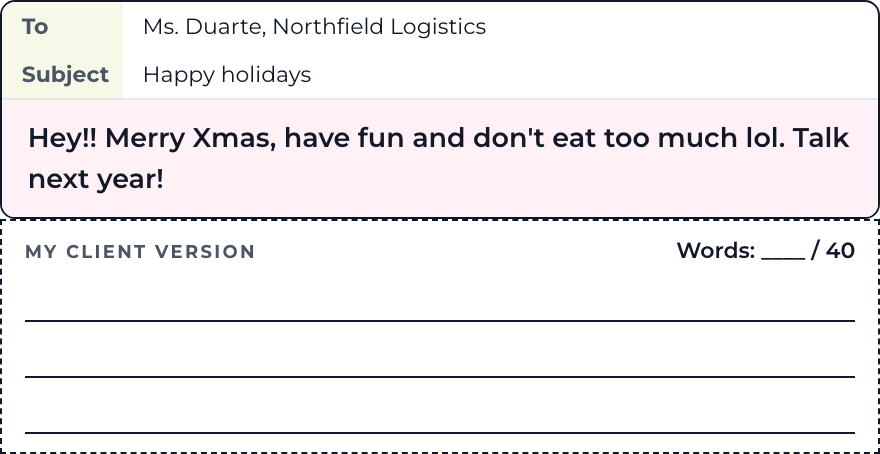
The lesson for this is Business Holiday Cards (B1-B2). It opens with two sample greetings for students to compare, then adjusts tone and word choice for clients, colleagues and executives.
The Out-of-Office Reply
Wednesday, December 23. Lucas's last day before the break. One client still wants new prices, and his inbox needs an out-of-office reply.
An out-of-office reply has four parts, in this order: a thank-you, the dates away, a contact for anything urgent, and when you'll reply. For work that has to wait, Let's pick this up in the first week of January moves it forward without any pressure.
For your notes Mistakes to listen for
| ||||||||||||||
6of 6B1-B215 minFree printable · page 6 Out of Office Put a reply in order, write your own, then move one job to January How it works
|
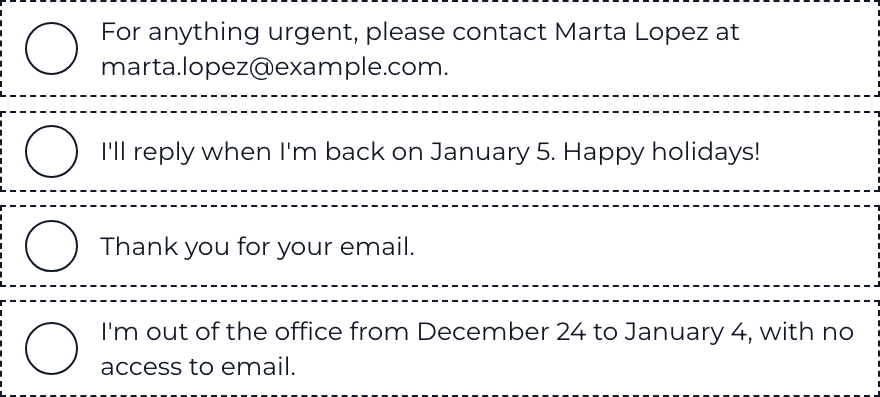
The January email is a follow-up in the making, and Follow-up Email (B1-B2) is the lesson for it: when to follow up, how to structure the email and polite language that isn't pushy, with a clear call to action.
Full Lessons for December at Work
When one of these moments deserves a whole hour, these lessons cover it. The free lesson first, then in the order of Lucas's December.
| Level | Lesson | What students do |
| B1-B2 | Phrasal Verbs for Work Free | Describe a working day with natural phrasal verbs |
| B2-C1 | The Office Gift Dilemma | Decline, question or suggest alternatives to workplace gifts |
| B1-B2 | Is It OK to Regift? | Discuss regifting and practice the passive voice |
| A2-B1 | The Art of Small Talk | Start, keep going and end a conversation |
| B1-B2 | Networking | Listen to two colleagues meet at an event and stay in touch |
| B1-B2 | Business Holiday Cards | Match the greeting to a client, a colleague or an executive |
| B1-B2 | Follow-up Email | Write a polite follow-up with a clear call to action |
Every lesson here except Phrasal Verbs for Work comes with a subscription. Compare the plans to see what each one includes.
For general English classes, 30 Christmas conversation questions for adults fill a whole last lesson, and our Christmas and New Year lesson plans by level put every seasonal lesson in one place. For Business English the rest of the year, try the Business English role play cards and the 30 work conversation questions.
Workplace Christmas English FAQ
Is "Merry Christmas" OK in a work email?
With colleagues you know celebrate, yes. With clients, Happy holidays or Season's greetings is safer, because it works for every reader.
How do I explain Secret Santa to students who have never done it?
Every person in the team draws one name in secret and buys a small gift for that colleague, within a price limit the team agrees on. The giver stays secret until the gifts are opened. Page 3 of the free pack shows it in four steps.
What if my students' company doesn't have a Christmas party?
Every phrase in this post works for any end-of-year or New Year event. Keep the language and change the name of the party.