Your Business English students don't need more vocabulary lists. They need to sit in an interview, answer an email or disagree in a meeting, and come out of it sounding like themselves. The fastest way to get them there is to rehearse the exact situations they face at work.
This post takes three of those situations: the job interview, the work email and the meeting. For each one you get the language to teach first, a short worksheet that practices it, and two role plays where each student holds half of the problem. Six activities in all, B1 to C1, and every one of them is in the free printable below, ready to cut out.
The six activities at a glance | # | Activity | Level | | 1 | Fix the AnswerThe Job Interview | B1-C115 min | | 2 | Interview Role PlaysThe Job Interview | B1-C125 min | | 3 | Too BluntWork Emails | B1-B215 min | | 4 | Email Role PlaysWork Emails | B1-B230 min | | 5 | The Softening LadderMeetings | B1-C115 min | | 6 | Meeting Role PlaysMeetings | B1-C125 min |
|
| Free · printable PDF · 8 pagesBusiness English Role Play CardsEvery activity in this post on its own page: three worksheets, six role plays with a secret goal on each card, and a teacher's page with the hidden clash, a fair ending and the language to listen for in each role play. B1 to C16 role plays12 role cards3 worksheetsTeacher's page | Scenario | Worksheet | Role plays | | The Job Interview | Fix the Answerpage 2 | The Gap Year + When Can You Start?page 3 | | Work Emails | Too Bluntpage 4 | Moving the Meeting + The Silent Supplierpage 5 | | Meetings | The Softening Ladderpage 6 | One More Project? + The Launch Datepage 7 |
Download the free PDFUS Letter |
Scenario 1: The job interview
A job interview is the most stressful hour of English most adults will ever have. The questions are predictable, which is good news: the language can be rehearsed. What students can't rehearse is the follow-up question, so the role plays add one on each card.
Teach this first. Three words come up in almost every interview: strengths, weaknesses and team player. Then give students two or three phrases that buy time, like That's a good question or Let me think for a moment. A pause with a phrase sounds calm. A pause in silence sounds like panic.
1of 6B1-C1Pairs or alone15 minFree printable · page 2 Fix the Answer Four weak interview answers, rewritten with situation, action and result How it works- On the worksheet, each common question comes with a weak answer: I'm a perfectionist. I work too hard.
- Students rewrite it in two or three sentences: the situation, what they did, and what changed. They invent the details if they need to.
- In pairs, one student asks the question and the other answers, first from the worksheet, then without it.
| What students practice Answers that tell one small story. A strong interview answer is short and specific, and the three-part frame gives students the order for it. The checklist under the table (a real example, a number, under one minute) works for self-study too. |
| Watch for Answers that stay general after the rewrite. I solved many problems becomes stronger only with one problem in it. Ask: Which one? When? |
| Phrases to put on the boardBuying timeThat's a good question.StrengthsFor example, last year I ...WeaknessesSomething I'm working on is ...ResultAs a result, ... |
| Free printable · page 2 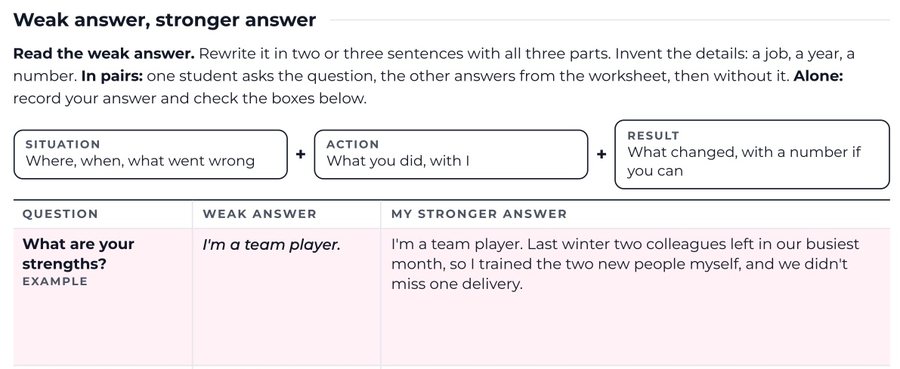
Page 2: four weak answers to rewrite, the situation, action, result frame, a self-check and phrases for buying time, strengths and weaknesses.Download the free PDFUS Letter |
|
The listening that models all of this is Job Interview (B1-B2): Charlie, a product manager, interviews Tom for a marketing job and tests his experience with direct questions. Students who will send a CV before the interview get the vocabulary for it in Job-Winning CV (B2-C1).
2of 6B1-C1Pairs or alone25 minFree printable · page 3 Interview Role Plays Two interviews, each with a secret goal on both cards How it works- Give Role A to one student and Role B to the other. They read their card alone for two minutes and underline one phrase they will use.
- They don't show their cards. The interviewer asks; the candidate answers and steers.
- At the end, each pair says what they agreed: Did the candidate get the job? On what start date?
| What students practice Answering the question behind the question. In both role plays the interviewer has a worry the candidate can't see on their card: - Role play 1, The Gap Year (B1): The candidate wants to move past the gap fast. The interviewer is really asking: will you leave too?
- Role play 2, When Can You Start? (B2-C1): Two weeks against a month's notice, and the candidate can't say yes on the spot.
|
| Watch for Candidates who apologize for the gap or the notice period. Both are normal. One clear sentence, then back to skills. |
| Free printable · page 3Role play 1, The Gap Year: the two cards, word for word.Candidate Role AYou are applying to be office manager at a logistics company. You were an office assistant for four years. Last year you did not work: you looked after your father after an operation.Secret goalExplain the gap in two sentences, then bring the talk back to your skills. Don't apologize for it.Useful phrases› I took a year out to ...› During that time, I organized ...› What I'm looking for now is ...vsInterviewer Role BYou are hiring an office manager. Ask about the candidate's experience, the gap in their CV and why they want this job.Secret goalThe last two office managers left after a few months. You need a person who will stay for at least two years.Useful phrases› Could you tell me about ...?› I noticed a gap in your CV. Could you ...?› Where do you see yourself in two years?Page 3 holds both interview role plays, with a line on every card for the student's first sentence.Download the free PDFUS Letter |
|
Interviews also change from country to country. In some cultures candidates are expected to sell themselves; in others, modesty is the polite choice. Doing Business Across Cultures (B2-C1) gives that conversation a full lesson: high- and low-context communication, hierarchy and feedback, with diplomatic phrases and role plays to finish.
Scenario 2: Work emails
Most of your students write more English than they speak. Emails are where their English is read, forwarded and remembered, and a message that is clear in their language can sound rude in English.
Teach this first. An email has four parts: a subject line that says what it is about, a greeting (Dear Ms. Lee or Hi Tom), a body that says why you are writing and what you need by when, and a closing like Looking forward to hearing from you. Compare a formal and an informal version of the same message, and let students point to the differences.
3of 6B1-B2Pairs or alone15 minFree printable · page 4 Too Blunt Rewrite four blunt email lines and three empty subject lines How it works- Each line on the worksheet is clear but too blunt: I need the report. Today.
- Students rewrite it so the reader still knows what they need, but wants to help.
- Then they write a clear subject line for three emails that arrived as Hi, Re: question and URGENT!!!
- In pairs, they swap worksheets and tick the rewrite they would answer first.
| What students practice Polite and direct in the same sentence. The worked example is the classic one: Hey, send me those files ASAP! becomes Could you send me the files by the end of the day? Thank you! The request and the deadline stay. Only the tone changes. |
| Watch for Rewrites so polite the request disappears. I was just wondering if maybe at some point... gets no reply either. Every rewrite keeps a clear ask and, where it fits, a date. |
| Phrases to put on the boardAskingCould you send me ... by ...?Following upJust checking you saw ...Bad newsI'm afraid we need to ...ClosingLooking forward to hearing from you. |
| Free printable · page 4 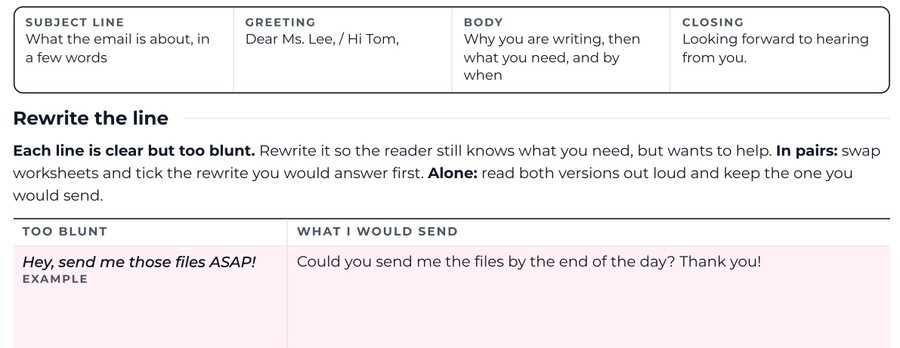
Page 4: the four parts of an email, four blunt lines to rewrite, three subject lines to fix, and phrases for asking, following up and bad news.Download the free PDFUS Letter |
|
4of 6B1-B2Pairs or alone30 minFree printable · page 5 Email Role Plays Two email exchanges, written on slips and passed across the table How it works- Role A writes the first email on a slip and passes it. Role B reads it and replies on the second slip.
- Role A answers once more on the back. Three emails, and the problem is solved or it isn't.
- Read a few exchanges out at the end. The class decides which email they would most like to receive.
| What students practice Writing to a real reader, who answers. Each card holds half of the problem: - Role play 3, Moving the Meeting (B1): One person can't do Thursday, the other can't wait until next week.
- Role play 4, The Silent Supplier (B1-B2): The buyer is annoyed and has a deadline. The supplier can only do part of the order.
|
| Watch for First emails with no reason or no deadline. If Role B has to ask When do you need it?, the first email missed something. |
| Free printable · page 5Role play 4, The Silent Supplier: the two cards, word for word.Office buyer · writes first Role AEight days ago you emailed a supplier for a price for 200 office chairs. Nobody has replied.Secret goalYou need the price by Friday, or your manager will order from another company. Write a follow-up that is firm but friendly.Useful phrases› I'm following up on my email of ...› Could you let me know by ...?› If that isn't possible, ...vsSupplier · replies Role BYou sell office furniture. Read the buyer's email and reply.Secret goalTheir first email went to your spam folder. You have 120 chairs in stock; the other 80 arrive in three weeks.Useful phrases› Apologies for the delay. ...› We can deliver ... now and the rest by ...› Would a partial delivery work for you?Page 5 holds both email role plays and two email slips to cut out: the first email and the reply.Download the free PDFUS Letter |
|
Role play 4 is a follow-up, and Follow-up Email (B1-B2) is the lesson for it: when a follow-up is appropriate, how to structure it, and polite language that isn't pushy, with a clear call to action. For the email students put off longest, Feedback requests (B1-B2) works through asking for feedback with model emails and role plays.
Scenario 3: Meetings
In meetings, your students often know exactly what they think and say nothing, because the only English they have for it sounds too strong. That's wrong is clear. It also ends the conversation.
Teach this first. Softening language: I see it a little differently, I'm not sure that's right, What if we...? Then the second half, which students forget: after the soft first sentence, say clearly what you want. Direct and indirect cultures both need it, in different amounts.
5of 6B1-C1Pairs or alone15 minFree printable · page 6 The Softening Ladder Take four blunt meeting lines two steps up How it works- Each row starts with a direct line: Your plan won't work.
- Students write a softer version, then a diplomatic one, where the second sentence still says what they want.
- In pairs, they say all three out loud. The partner says which one they would use in their own meetings.
| What students practice Choosing how direct to be. Students see that diplomatic is not the same as vague, and they leave with three ways to say the same thing. |
| Watch for The diplomatic version that has lost the point. If the partner can't say what the speaker wants, it went one step too far. |
| Phrases to put on the boardDisagreeingI see it a little differently.DisagreeingI take your point, but ...Saying noWhat I could do is ...Moving it onSo what we agree on is ... |
| Free printable · page 6 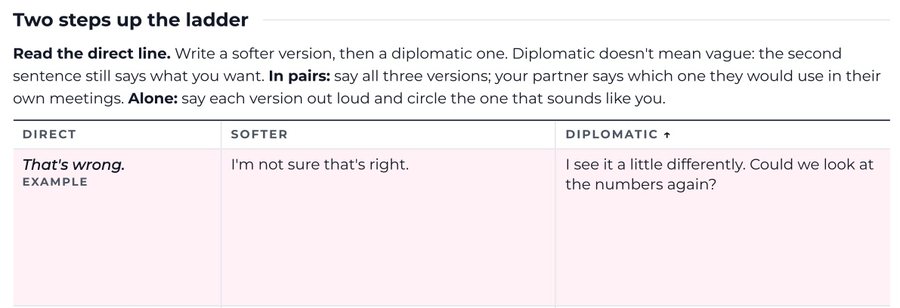
Page 6: the ladder with a worked example, four blunt meeting lines and phrases for disagreeing, saying no and moving a meeting on.Download the free PDFUS Letter |
|
6of 6B1-C1Pairs or alone25 minFree printable · page 7 Meeting Role Plays Two meetings where both sides are right How it works- Pairs, as in activity 2: secret cards, two minutes to prepare, one phrase underlined.
- In role play 5 the designer can't say the word no. In role play 6 the sales manager and the product lead have to leave with one message for the client.
- Pairs report what they agreed. Then they swap cards and play it again.
| What students practice Disagreeing and saying no without damage. - Role play 5, One More Project? (B1-B2): The team lead needs a yes. The designer has no time and doesn't want to sound unhelpful.
- Role play 6, The Launch Date (B2-C1): A promise already made against a date nobody can meet. Both are right.
|
| Watch for Students who give in at the first push. A fair ending gives each side something, and the teacher's page has one for every role play. |
| Free printable · page 7Role play 5, One More Project?: the two cards, word for word.Team lead Role AIt's the weekly team meeting. A new client, a bakery chain, wants a new website in three weeks.Secret goalYou want your best designer to lead it. Get a yes, or a plan you can live with.Useful phrases› I'd like you to take the lead on ...› How does that sound?› What would you need to make it work?vsDesigner Role BYou are in the weekly team meeting. You already lead two projects, and one of them launches next week.Secret goalSay no without saying the word no. Offer something else: a later start, a smaller part of the job, or help for a colleague who leads it.Useful phrases› I'd love to, but at the moment ...› What I could do is ...› If we moved ..., I could ...Page 7 holds both meeting role plays. Page 8, the teacher's page, has the clash, a fair ending and the language to listen for in all six.Download the free PDFUS Letter |
|
Role play 5 is the situation in Saying No (B1-B2): a project manager turns down a client's new requirements one strategy at a time. Role play 6 sits next to Missed Deadlines (B2-C1), where a product manager and a developer talk through a deadline that has already slipped. For a group that runs meetings, How To Run A Meeting (B2-C1) follows Alice, a product manager, as her team works through a feature with performance problems. For the give and take that ends every role play, Bargaining (B1-B2) is free: offers, flexibility and reaching an agreement.
Business English Role Play CardsThe three worksheets, all twelve role cards and the teacher's page in one free PDF, in the order of this post.Download the free PDF |
After the role play: feedback that sticks
Walk around and write down what you hear, good and bad. Don't stop a negotiation to fix an article. When the pairs have reported back, put three phrases on the board that worked and three that need fixing, and let the class rewrite them. Then swap the cards and play it again. The second round is always better, because now each student knows what the other side wanted.
End with one question: Which of these situations will you have this month? The answer tells you what to rehearse next.
Mistakes your students will make
Teacher's reference Business English slips to listen for | Students say | Better | | I'm responsible of the budget. | I'm responsible for the budget. | | Responsible takes for. It comes up in every interview answer about a past job. | | I look forward to hear from you. | I look forward to hearing from you. | | Here to is a preposition, so the verb after it takes -ing. The most common email closing slip. | | Can we discuss about the deadline? | Can we discuss the deadline? | | Discuss takes a direct object. Talk about is the one with about. | | I have a doubt about the price. | I have a question about the price. | | In Spanish, Portuguese and Italian a doubt is a question. In English it means you don't believe something. | | We need to postpone the meeting for next week. | We need to postpone the meeting until next week. | | You postpone something until or to a new time. Role play 3. | | I am agree with you. | I agree with you. | | Agree is a verb, not an adjective. Listen for it in every meeting role play. |
|
Business English lessons for these scenarios
Free lessons first, then by scenario: interviews, emails, meetings.
Want more situations? Our 12 ESL role play scenarios for adults cover everyday life, from a hotel check-in to asking for a raise, and the 30 work conversation questions make an easy first lesson with a new Business English student. For the bigger picture, read how teaching Business English differs from general ESL.