Funny Tongue Twisters for ESL Pronunciation Practice (Free Printable Sound Cards)
October 27, 2026
Table of Contents
- Short Funny Tongue Twisters for Beginners
- Funny Tongue Twisters Sorted by Sound
- TH Tongue Twisters
- R Tongue Twisters and L Sounds
- V and W Tongue Twisters
- Short and Long Vowel Tongue Twisters
- S and SH Tongue Twisters
- -ed Ending Tongue Twisters
- Funny Tongue Twisters for Adults
- The Hardest English Tongue Twisters
- How to Use Tongue Twisters for Pronunciation
- Which Sounds to Practice by Students' First Language
- Pronunciation Lessons Ready to Teach
- Tongue Twisters FAQ
"If a dog chews shoes, whose shoes does he choose?" Say it three times fast, and your class is already laughing, which is the whole point. This article collects 65 funny tongue twisters, sorted by the sounds learners really struggle with, plus five ways to turn them into pronunciation practice. Some are classics, and more than half were written for this page, so you won't find them in every other list. ESL tongue twisters make a two-minute warm-up, a focused drill or a team game, from A1 beginners to tongue twisters for adults at C1.
Every section has its own page in a free printable pack, the Tongue Twister Sound Cards. Students practice in pairs or alone, and you never read a word aloud. Where a twister trains the same sound as a full lesson in our pronunciation section, the lesson is right under it.
The sections at a glance
|
|
Short Funny Tongue Twisters for Beginners
Start with short tongue twisters that fit in one breath. Students say each one slowly three times before they try it fast, because speed always comes last. Write the twister on the board, read it once yourself, then have the class repeat it in chorus. Chorus work takes the pressure off, and nobody is singled out for a mistake in the first week. Once the whole class can say it, ask for volunteers.
- Toy boat, toy boat, toy boat.
- Red leather, yellow leather.
- Unique New York, you know you need unique New York.
- Fresh fried fish.
- A big black bug bit a big black bear.
- Kate's cat can't catch Carl's cap.
- Pink pigs prefer purple pancakes.
- Bob's blue bike broke by the bakery.
- Mom made Max make more muffins.
- Greg grabbed a green grape.
1 2 3Free printable · page 1Short twisters: the speed ladder The three rungs on the page1 · Slow: word by word2 · Normal: like talking to a friend3 · Fast: three times, no break All ten twisters sit on the ladder. Partner B ticks each clean rung and counts slips; a student alone records rung 3 and listens. Download the free PDF |
Funny Tongue Twisters Sorted by Sound
Most learners don't struggle with English pronunciation in general. They struggle with a few consonant sounds and vowel sounds that their first language doesn't have. Grouping the twisters by sound lets you aim practice exactly where your students need it. Pick one group per lesson and stay with it for a week or two, so the new mouth position has time to become a habit.
TH Tongue Twisters
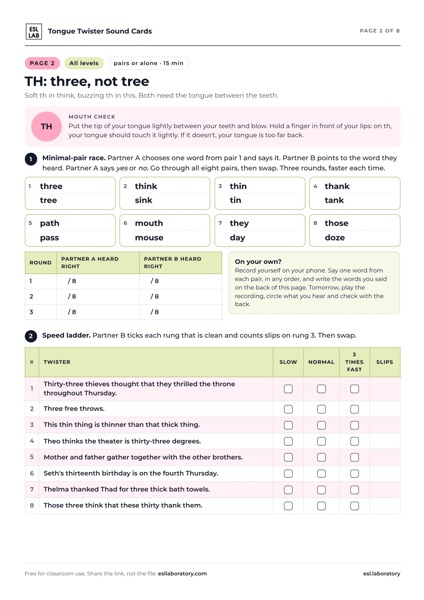
For th, the tip of the tongue rests lightly between the teeth and air flows over it. Students who say "tree" for three or "zis" for this are keeping the tongue behind the teeth. These th tongue twisters mix the soft th in think with the buzzing th in this. Ask students to hold a finger in front of their lips. If the tongue doesn't touch it lightly on th, it is too far back.
- Thirty-three thieves thought that they thrilled the throne throughout Thursday.
- Three free throws.
- This thin thing is thinner than that thick thing.
- Theo thinks the theater is thirty-three degrees.
- Mother and father gather together with the other brothers.
- Seth's thirteenth birthday is on the fourth Thursday.
- Thelma thanked Thad for three thick bath towels.
- Those three think that these thirty thank them.
THFree printable · page 2TH: three, not tree Minimal-pair race on the pagethree / treethink / sinkthin / tinthank / tankpath / passmouth / mousethey / daythose / doze Mouth check: Put the tip of your tongue lightly between your teeth and blow. Then a speed ladder with the 8 twisters above. Download the free PDF |
R Tongue Twisters and L Sounds
Japanese and Korean speakers often find r and l hard to tell apart, because their first languages don't separate the two sounds the way English does. For an American r, the tongue pulls back and never touches the roof of the mouth. For l, the tip touches the ridge just behind the top teeth. Use these r tongue twisters slowly first, and let students exaggerate the r. A pair like right and light on the board before the list shows them why the sound matters.
- Lesser leather never weathered wetter weather better.
- Truly rural.
- Rubber baby buggy bumpers.
- Willy's real rear wheel.
- Larry's red truck rolled really slowly along the rainy road.
- Laura rarely reads real letters.
- Ralph left the long rope and the loud radio in the library.
- Rory's rabbit really loves lettuce rolls.
R · LFree printable · page 3R and L: right, not light Minimal-pair race on the pageright / lightread / leadrock / lockgrass / glassfry / flypray / playcorrect / collectrake / lake Mouth check: For r, pull your tongue back. Then a speed ladder with the 8 twisters above. Download the free PDF |
V and W Tongue Twisters
For v, the top teeth touch the bottom lip. For w, the lips round and the teeth stay out of the way. Speakers of German, Hindi and Ukrainian often swap the two, so "very well" comes out as "wery vell". A mirror helps here. If students can see their teeth on w, they are making v.
- Which witch is which?
- Wayne went to Wales to watch walruses.
- Vera's van went west while Will's wagon went to Venice.
- Very well, Walter, we will wear warm velvet vests.
- Vince wants weird violet wallpaper.
- Seven waiters wave at eleven visitors.
V · WFree printable · page 4V and W: very well, not wery vell Minimal-pair race on the pagevest / westvet / wetvine / wineveil / whalevow / wowverse / worsevent / wentviper / wiper Mouth check: For v, your top teeth touch your bottom lip. Then a speed ladder with the 6 twisters above. Download the free PDF |
Short and Long Vowel Tongue Twisters
English has pairs of short and long vowels, as in ship and sheep or full and fool. Many languages have only one sound for each pair, so these minimal pairs are where meaning gets lost. Exaggerate the long vowels at first. Students can relax them later.
- I wish to wish the wish you wish to wish.
- Is this sheep's ship cheap, or is this ship's sheep cheaper?
- Will Phil feel ill if he fills the pill box?
- Look, Luke! The good cook took the food to the room.
- Jim's green gym is full of keen kids.
- The fool pulled the pool toy out of the full pool.
i · eeFree printable · page 5Short and long vowels: ship or sheep? Minimal-pair race on the pageship / sheeplive / leavefill / feelsit / seatbin / beanfull / foolpull / poollook / Luke Mouth check: For the long vowels in sheep and pool, hold the sound longer and make it too long at first. Then a speed ladder with the 6 twisters above. Download the free PDF |
Where the race leads Minimal Pairs (A2-B1) drills the same contrasts, ship and sheep, pull and pool, plus pen and pan and cup and cop, with listening tasks, short poems and partner games. For B2-C1, Crafting change looks at how one of these vowels changes in the Liverpool accent. |
S and SH Tongue Twisters
For s, the lips stay relaxed and the tongue sits close to the ridge behind the teeth. For sh, the lips push forward and round. Spanish speakers often say s for sh, and Japanese speakers often say "she" for see. Practice the pair sip and ship slowly before the list. Then ask students to whisper the twisters, which makes the hiss of s and the hush of sh much easier to hear.
- She sells seashells by the seashore.
- Six slippery snails slid slowly seaward.
- Irish wristwatch, Swiss wristwatch.
- The seething sea ceaseth, and thus the seething sea sufficeth us.
- Sally shared six short sushi rolls with Shawn.
- Sasha's shop sells shiny silver shoes.
S · SHFree printable · page 6S and SH: sip, not ship Minimal-pair race on the pagesip / shipsee / shesort / shortsave / shavesell / shellseat / sheetsock / shockmass / mash Mouth check: For s, keep your lips relaxed and your tongue close to the ridge behind your top teeth. Then a speed ladder with the 6 twisters above. Download the free PDF |
-ed Ending Tongue Twisters
Regular past verbs all end in -ed, but the sound changes. After t and d, the ending adds a syllable, as in wanted. After sounds like p, k, s and f, it sounds like t, as in jumped. After other sounds, it sounds like d, as in played. Many students add the extra syllable everywhere and say "walk-ed". These six twisters were written for this page, and each one packs two to four -ed verbs into one line.
- Ted wanted ten painted ducks for his bathtub.
- Kate cooked, cleaned and counted the cookies.
- Mike missed the bus, so he walked, jogged and waited.
- Dan danced, Dean dreamed, and Dad just needed a nap.
- Lisa laughed, played and planted pink tulips.
- The cat jumped, landed and loved it.
-edFree printable · page 7The -ed ending: t, d or id? The sort on the paget: jumped, walkedd: played, cleanedid: wanted, needed Students say each twister slowly, count the syllables in every verb and sort all 18 verbs into three columns. The answers are upside down at the bottom. Download the free PDF |
The full lesson The -ed ending (A1-A2) teaches the same three endings through a dinner-party story, listening tasks and a storytelling game, so these twisters make a two-minute warm-up for it. |
Funny Tongue Twisters for Adults
These are longer, and they suit B2-C1 students who want a real challenge. Funny tongue twisters for adults also work in business English classes and conversation clubs, where a laugh breaks the ice faster than any introduction round. Silly tongue twisters about office life land especially well with working adults. Give the vocabulary a minute first, since words like peck and woodchuck are new to most learners.
- Peter Piper picked a peck of pickled peppers. If Peter Piper picked a peck of pickled peppers, where's the peck of pickled peppers Peter Piper picked?
- How much wood would a woodchuck chuck if a woodchuck could chuck wood?
- Betty Botter bought some butter, but she said the butter's bitter.
- Can you can a can as a canner can can a can?
- The project manager managed to mismanage the management meeting, so the managers made the manager manage it again.
- Brenda's brand-new blender blended bright blueberry smoothies brilliantly.
- Clara crossed the crowded crosswalk carrying crates of crisp crackers.
- The careful accountant counted the countless accounts until the count came out right.
- Printing the printer's price list priced the printer out of printing.
- Fred's friend Fran fries French fries for free on Fridays.
At full speed, the words in a long twister start to run together and small sounds disappear. That is exactly what happens in fast, natural speech, and it is why so many adults understand a textbook recording but not a real colleague.
For business classes Winning Video Ads (A2-B1) has students talk about what makes a social media ad work, then follow a fast, natural speaker and notice the sounds that drop out. |
The Hardest English Tongue Twisters
These are the hard tongue twisters that break even native speakers. Each comment shows where the tongue usually trips.
- Pad kid poured curd pulled cod. In 2013, speech researchers at MIT presented it as the hardest twister in their study, and some volunteers simply stopped talking. The p, k and d sounds jump between the lips, the back of the mouth and the teeth.
- The sixth sick sheikh's sixth sheep's sick. Guinness World Records once listed it as the hardest in English. The x in sixth, then s, then sh, all in a row, ties the tongue in a knot.
- Eleven benevolent elephants. The l and v keep switching, and the stress falls in a different place in each word.
- Rural juror. Only two words, but the r and l sit so close together that most people give up by the third try.
- Sixty-six thistle sticks stuck in sixty-six thick stacks. The s and th sounds alternate in nearly every word, so the tongue never rests.
5Free printable · page 8Twister challenge What else is on the pageThe hardest five, three tries eachA team scoreboardA frame to write your own The model in the frame: Shy Shawn shares shiny shells at the shore. Students tick a checklist before they swap: six words with the sound, one breath, it makes sense, it is funny. Download the free PDF |
How to Use Tongue Twisters for Pronunciation
A twister on its own is a party trick. With a plan, it becomes one of the most efficient ESL pronunciation activities you have, because it trains mouth position, stress and rhythm in a few seconds. Here are five ways to use tongue twisters for pronunciation.
- Slow, then fast. Students say the twister slowly, word by word, then at normal speed, then as fast as they can. Correct the target sound only at the slow stage. At normal speed, listen for the beat: the content words stay strong and the small words go weak, which is the system Sentence Stress (A2-B1) teaches. At top speed, words run into each other, and Link it up (A2-B1) turns that into linking rules students can use. This works well as a warm-up, and our list of ESL warm-up activities has more ideas for the first five minutes.
- The chain. One student says the twister, the next says it faster, and so on around the room. If a student trips, the chain starts again from the beginning. The pressure is friendly, and everyone hears the line many times before their turn.
- Record and compare. Students record themselves on a phone, listen once, and record again. Hearing their own voice shows them exactly which sound breaks. It also gives quiet students a way to practice without an audience, and every page of the pack has an "on your own" option built on it.
- Team competition. Teams choose a speaker for each round. The speaker who says the twister three times without a mistake wins a point. Add a time limit for advanced classes. The scoreboard is on page 8, and our post on speaking games has more formats for team play.
- Write your own. Give groups a target sound and five minutes to write one of their own funny English tongue twisters, with at least six words that use it. Then groups swap and try each other's. Writing one forces students to think about phonetics, and they always find it harder than reading one. Page 8 has the frame. In a speaking club setting, this makes a good closing round.
| Tongue Twister Sound CardsPages 1 to 8 follow the sections of this post, in the same order.Download the free PDFUS Letter: PDF |
Which Sounds to Practice by Students' First Language
Use this table as a starting point, not a rule. Listen to each student first, then pick the section that matches what you hear.
| First language | Often difficult | Start with |
| Spanish | b and v, s and sh, ship and sheep | Short and long vowels (page 5), S and SH (page 6) |
| Portuguese | th, short and long vowels | TH (page 2), short and long vowels (page 5) |
| Chinese | th, v and w, word endings | TH (page 2), V and W (page 4), -ed (page 7) |
| Japanese | r and l, th, s and sh | R and L (page 3), TH (page 2), S and SH (page 6) |
| Ukrainian | v and w, th, short and long vowels | V and W (page 4), TH (page 2) |
| Arabic | p and b, v and f, short vowels | Beginners (page 1), short and long vowels (page 5) |
In a mixed class, run two sections in the same lesson and let students choose the one they need. Learners usually know which sound gives them trouble, and choosing their own list makes the practice feel less like a test.
Pronunciation Lessons Ready to Teach
Tongue twisters warm up the mouth, and full lessons teach the system behind the sounds. Our pronunciation section has six lessons, from -ed endings at A1-A2 to a Liverpool accent at B2-C1. Each one builds the target sound into real speech rather than only into drills.
| Level | Lesson | Goes with |
| A1-A2 | The -ed ending | -ed endings, page 7 |
| A2-B1 | Minimal Pairs | Short and long vowels, page 5 |
| A2-B1 | Sentence Stress | Slow, then fast |
| A2-B1 | Link it up | Slow, then fast |
| A2-B1 | Winning Video Ads | Twisters for adults |
| B2-C1 | Crafting change | Short and long vowels |
Standard gives you the lesson PDFs and a Quizlet set for every lesson, Plus adds homework, and Pro adds Miro boards, interactive homework and games. Compare plans.
Tongue Twisters FAQ
Do tongue twisters really improve pronunciation?
They help when students practice slowly and focus on one sound. Fast repetition on its own mostly builds confidence. Use them alongside listening and minimal pairs, not instead of them. The biggest gains come when students know which sound they are working on.
How much class time should they take?
Two to five minutes. Use one as a warm-up or between activities. Any longer, and the laughing turns into frustration. A short twister at the start of every class works better than a long session once a month.
What age are they for?
Every twister here works for teens and adults. The beginner list suits A1-A2 at any age, and the adult list suits B2-C1.
How can I measure progress?
Record students saying the same twister in week one and week six, then play both. The difference is usually clear, and it motivates more than a grade.
Do I need to sign up to download the sound cards?
No. The Tongue Twister Sound Cards are a direct download, in A4 and US Letter.