Lexical Approach Activities: How to Extend Any ESL Vocabulary Worksheet (Free Templates)

January 19, 2026

Lexical Approach Activities: How to Extend Any ESL Vocabulary Worksheet (Free Templates)

Table of Contents


You're teaching winter weather vocabulary. Your students work through the worksheet: matching, gap-fills, sentence completion. They know the words now: snow, frost, hail, blizzard. They can define every one. Then you ask them to warn a friend about the roads tonight, and they stop.

The worksheet did its job. It taught the words. What it didn't teach is the language around them: heavy snow, covered with ice, Watch out for black ice. This post shows you how to add that layer to any vocabulary worksheet you already use, one exercise type at a time.

Each extension comes as a blank template in the free printable, so you can reuse it with any topic. Pages 8 and 9 show all six filled in for a winter weather worksheet.

What the lexical approach says

Michael Lewis set out the lexical approach in his 1993 book The Lexical Approach. His central claim is that "language consists of grammaticalised lexis, not lexicalised grammar". In plain terms: fluent speakers don't build sentences one word at a time from grammar rules. They reach for ready-made chunks and fit them together. Lewis saw this as a development of communicative teaching, not a break with it.

Corpus research supports the idea. In a well-known study, Erman and Warren (2000) found that roughly half of the English text they analyzed was made of these prefabricated combinations. Other studies give higher or lower figures, depending on how a chunk is counted, but the point holds: a large part of everyday English is reused, not invented.

For a worksheet, that means looking for three kinds of chunk around each new word:

Kind of chunkWhat it isWinter example
CollocationTwo or three words that usually go togetherheavy snow, black ice, the roads are slippery
Fixed expressionA phrase you say the same way every timeBe careful! Stay safe.
Sentence frameThe start of a sentence with a gap to fillWatch out for ... We're expecting ...
What this means for your worksheet

Keep it. The lexical approach doesn't replace controlled practice. It adds one step after it: students go back to the words they now understand and collect the chunks those words live in. That step is what each template below is for.

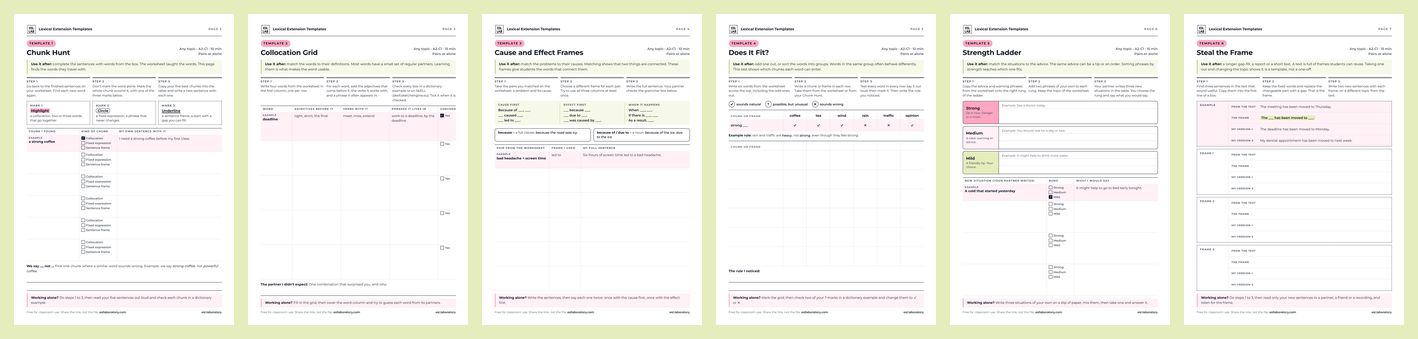
Free · printable PDF · 9 pagesLexical Extension TemplatesSix blank templates you can use with any worksheet, all year, and a worked example on winter weather. Find the exercise on your worksheet and print the page next to it:
If your worksheet hasUsePage
Complete the sentences with words from the box1 · Chunk Huntp. 2
Match the words to their definitions2 · Collocation Gridp. 3
Match the problems to their causes3 · Cause and Effect Framesp. 4
Odd one out, or sort the words into groups4 · Does It Fit?p. 5
Match the situations to the advice5 · Strength Ladderp. 6
A longer gap-fill, a report or a short text6 · Steal the Framep. 7
Not sure what a finished one looks likeWorked example: winterp. 8-9
The six blank templates, pages 2 to 7Download the free PDFUS Letter

Six worksheet exercises and how to extend them

These six exercise types turn up in most vocabulary worksheets. Each extension takes 10 to 15 minutes after the worksheet is checked, and works for pairs, one-to-one lessons or a student working alone.

1. Complete the sentences with words from the box: Chunk Hunt

The most common worksheet exercise, and the easiest one to extend.

1of 6Any topicPairs or alone10 minFree printable · page 2

Chunk Hunt

After: complete the sentences with words from the box

What the worksheet does

Students read ten or twelve sentences, each with one target word, and fill the gaps from a box: It's snowing heavily. The pond is covered with ice. Be careful! The sidewalk is slippery.

The lexical extension
  • When the answers are checked, students go back to the sentences and find each new word again.
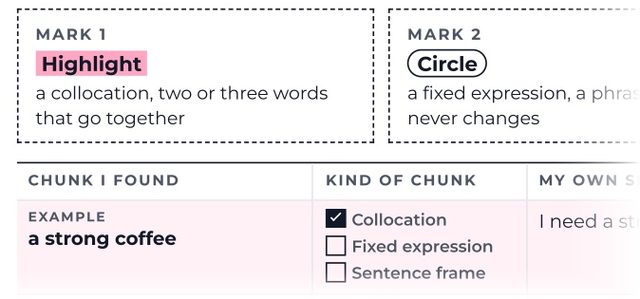
  • They don't mark the word alone. They mark the chunk around it: highlight a collocation, circle a fixed expression, underline a sentence frame.
  • They copy their five best chunks into the template and write a new sentence with each one.
  • Finish with one question for the class: Why do we say snowing heavily and not snowing strongly?
Why it works

It moves attention from the word to its neighbors. The sentences were already on the page, so the chunks cost no extra prep, and students see that the worksheet held more language than they noticed.

Watch for

Students who highlight whole sentences, or just the target word again. A chunk is short, usually two to five words, and it comes back together in other sentences.

Blank · free printable page 2The blank Chunk Hunt template, page 2Filled in for winter · page 8
ChunkKindNew sentence
heavy snowCollocationHeavy snow closed the mountain road last night.
covered with iceCollocationThe car was covered with ice this morning.
Be careful!Fixed expressionBe careful! The steps are slippery.
Download the free PDFUS Letter

The winter examples in this post follow When Winter Gets Rough (B1-B2), our winter weather worksheet. Students match words like blizzard, black ice, frost and windchill to their definitions, connect them to the problems they cause and use them in warnings. Pages 8 and 9 of the templates show that kind of worksheet, extended.

2. Match the words to their definitions: Collocation Grid

Matching gives students the meaning. The grid gives them the words that come with it.

2of 6Any topicPairs or alone15 minFree printable · page 3

Collocation Grid

After: match the words to their definitions

What the worksheet does

Students match each word to its definition: sleet is a mix of rain and snow, black ice is thin, clear ice on a road.

The lexical extension
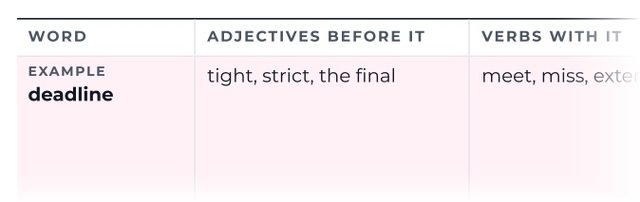
  • Students write four words from the worksheet in the template, one per row.
  • For each word they add the adjectives that come before it, the verbs it works with, and a phrase it often appears in.
  • Pairs pool what they know, then check every box in a learner's dictionary or on SkELL, a free tool that shows real example sentences. They tick a box only when it is checked.
Why it works

Most words have a small set of regular partners, and knowing them is what makes a word usable. Snow alone is a noun. Heavy snow is expected is a sentence your students can say tomorrow.

Watch for

Collocations that sound right but aren't. Students will offer strong snow or make a photo with confidence. That is why the checking column is there, and why it comes before the speaking.

Blank · free printable page 3The blank Collocation Grid template, page 3Filled in for winter · page 8
WordAdjectivesVerbs
snowheavy, light, freshfalls, melts, covers
iceblack, thinforms, melts, covers
frosthard, light, earlyforms, covers
Download the free PDFUS Letter

For the two verbs that cause the most collocation trouble, Make vs Do Collocations (B1-B2) works through more than fifty of them by topic, with a reference chart. Dating Collocations (B1-B2) does the same for twelve relationship phrases, like take things slow and settle down. To try the grid on a free worksheet first, Words to Describe Autumn Free (A2-B1) has twelve words for students who only know cold.

3. Match the problems to their causes: Cause and Effect Frames

Matching shows that two things are connected. These frames give students the words that connect them.

3of 6Any topicPairs or alone10 minFree printable · page 4

Cause and Effect Frames

After: match the problems to their causes

What the worksheet does

Students match problems to their causes: The grass looks white but it isn't snowing goes with frost on the grass.

The lexical extension
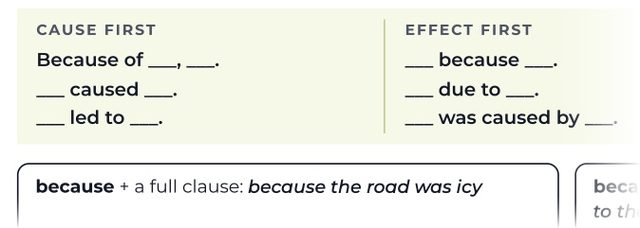
  • Students take the pairs they matched and choose a different frame for each one: Because of ___, ___, ___ due to ___, When ___, ___.
  • They write the full sentence for every pair, trying each column of frames at least once.
  • The partner checks one thing only: the grammar box on the template.
Why it works

Students already know which cause goes with which problem. Now they practice the connecting language they will need to explain any problem in English: because of, due to, caused by, when, if.

Watch for

Because of the roads were icy. Because takes a full clause, because of and due to take a noun. The template prints the rule, so the partner can check it without you.

Blank · free printable page 4The blank Cause and Effect Frames template, page 4Filled in for winter · page 8
PairFrameSentence
Many cars crashed + black icedue toMany cars crashed on the highway due to black ice.
The grass looks white + frostbecauseThe grass looks white because there was a frost last night.
Download the free PDFUS Letter

4. Odd one out: Does It Fit?

Words in the same group often behave differently. This test shows students exactly where.

4of 6Any topicPairs or alone10 minFree printable · page 5

Does It Fit?

After: odd one out, or sort the words into groups

What the worksheet does

Students find the word that doesn't belong: snow, sleet, hail, windchill. Windchill is the odd one out, because the others fall from the sky.

The lexical extension
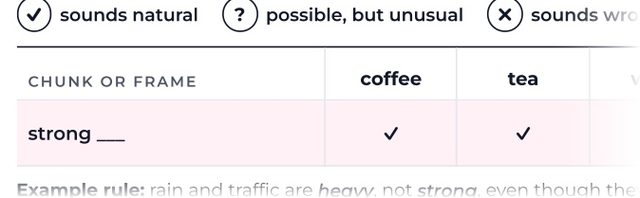
  • Students write six words across the top of the grid, including the odd ones out.
  • Down the side they write chunks or frames from the worksheet: Heavy ___ is falling, Watch out for ___ on the roads.
  • They test every word in every row out loud and mark it: natural, possible but unusual, or wrong.
  • Last, they write the rule they noticed.
Why it works

Students discover the restrictions themselves. Heavy snow and heavy rain work, but frost and ice don't fall: they form. A rule students find in their own grid stays with them longer than one you explain.

Watch for

Long arguments over the question marks. Let students keep a question mark, then check two of them in a dictionary example and change them to a tick or a cross.

Blank · free printable page 5The blank Does It Fit? template, page 5Filled in for winter · page 9
Framesnowrainfrostice
Heavy ___ is falling.✓✓✗✗
light ___✓✓✓✗
Download the free PDFUS Letter

At A1-A2, run the grid with Weather Vocabulary, our everyday weather worksheet: sunny, foggy, cool. Simple frames like It's very ___ today are enough to show that some words fit and some don't.

5. Match the situations to the advice: Strength Ladder

The same advice can be a friendly tip or an order. Sorting by strength teaches which one fits.

5of 6Any topicPairs or alone15 minFree printable · page 6

Strength Ladder

After: match the situations to the advice

What the worksheet does

Students match situations to advice: black ice on the roads goes with Drive very slowly or don't drive.

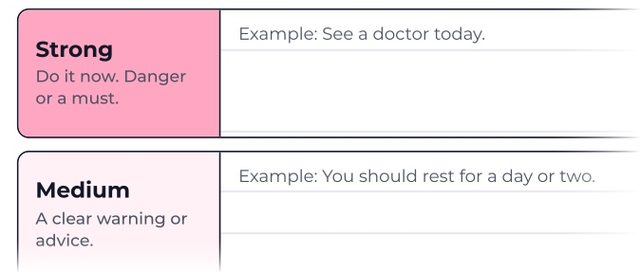
The lexical extension
  • Students copy the advice and warning phrases from the worksheet onto three rungs: strong, medium and mild.
  • They add two phrases of their own to each rung, on the same topic.
  • The partner writes three new situations, like light frost overnight or a blizzard with almost zero visibility. The student chooses the rung and says what they would say.
Why it works

Advice and warnings are mostly chunks: Stay indoors, Watch out for, It's a good idea to. Sorting them by strength teaches register along with the words, and the new situations make students choose.

Watch for

Every answer landing on the strong rung. Adults often use imperatives for everything, which sounds rude for a small risk. Ask what they would say to a friend about light frost.

Blank · free printable page 6The blank Strength Ladder template, page 6Filled in for winter · page 9
RungPhrases
StrongStay indoors. · Do not drive unless you have to. · Avoid travel tonight.
MediumWatch out for black ice. · Drive slowly. · Allow extra time.
MildIt's a good idea to check the forecast. · You might want to leave early.
Download the free PDFUS Letter

6. A longer gap-fill: Steal the Frame

A longer text is full of frames students can reuse. This is the extension that shows them chunks are templates.

6of 6Any topicPairs or alone15 minFree printable · page 7

Steal the Frame

After: a longer gap-fill, a report or a short text

What the worksheet does

Students complete the gaps in a weather report: A major winter storm is approaching our area. We're expecting heavy ___ starting this afternoon.

The lexical extension
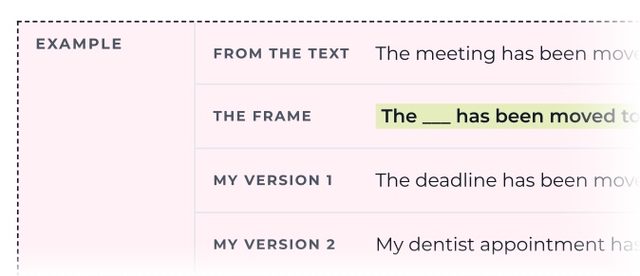
  • Students find three useful sentences in the finished text and copy them into the template.
  • They keep the fixed words and turn the changeable part into a gap. That is the frame: A ___ is approaching ___.
  • They write two new sentences with each frame on a different topic: A heat wave is approaching the south coast.
Why it works

Changing the topic proves the frame is portable. Students leave with a sentence they can use for any forecast, delay or announcement, not just the one in the text.

Watch for

Students who change the fixed part too. If is approaching turns into is coming near to, the frame is gone. Only the gaps change.

Blank · free printable page 7The blank Steal the Frame template, page 7Filled in for winter · page 9
The frameMy new sentence
A ___ is approaching ___.A heat wave is approaching the south coast.
___ will create ___ conditions.Heavy rain will create dangerous driving conditions.
Download the free PDFUS Letter

Any worksheet with a short text works here. Phrasal Verbs for Work Free (B1-B2) describes an ordinary working day, full of frames like I need to get through ___ before ___. Cosy Autumn Vocabulary (B1-B2) teaches twelve phrases that are already chunks, so students can start at step 2.

Lexical Extension TemplatesAll six templates, blank and ready to reuse, plus the worked winter example, in one free PDF.Download the free PDF

Three speaking follow-ups for any vocabulary worksheet

Once students have their chunks, they need to use them without the page. These three tasks work with any topic. Ask students to keep their Chunk Hunt list open and tick each chunk they manage to use.

ANo printingAny topicPairs10 min

The Personal Experience Story

Students tell a partner about a real experience connected to the topic. For winter weather: Tell your partner about a time winter weather caused you a problem. What happened? What did you do?

  • The story has to include one chunk that describes the situation, one that explains a cause or effect, and one piece of advice.
  • The partner listens for the three and asks one follow-up question at the end.

For a lighter version at A2-B1, What's the Weather Like Today? builds the everyday weather small talk that this story grows out of.

BNo printingAny topicPairs15 min

The Expert Role-Play

One student is the expert, the other asks questions. For winter weather: a radio weather reporter gives the forecast, and a caller phones in about the roads, timing and safety.

  • The expert describes the situation with accurate chunks and gives warnings that match how serious it is.
  • The caller asks real questions and reacts naturally: Should I leave early? Is it safe to drive?

At B2-C1, Weather Forecast gives this role-play a full hour, with forecast language and a real forecast to work from.

CNo printingAny topicGroups of 3-410 min

The Collaborative Text Message Chain

The group writes a realistic text conversation that uses the target chunks. For winter weather: friends warning each other about a storm and changing their plans.

  • Each person sends three or four short, informal messages.
  • The chunks have to sound natural, not forced into the chat.
An example chainMariaHeavy snow starting soon!JohnHow much?Maria20-30 cm. Roads will be slipperySaraLeave work early?JohnYeah, avoid the evening trafficMariaWatch out for black iceSaraThanks for the heads-up!

Common slips when you go lexical

Teacher's reference

Five things that make chunk work harder than it needs to be

Instead ofTry
Twenty collocations for one wordThree or four partners per word
Students remember the partners they use. Pick the ones they will need this month, and leave the rest for the dictionary.
Highlighting the new wordHighlighting the chunk around it
The word is already known after the worksheet. The value is in the two or three words next to it.
A collocation that sounds right to youA quick check before you teach it
Teachers invent collocations too, especially in a second language. A learner's dictionary example or SkELL settles it in seconds.
Correcting every chunk in the speaking taskNoting two and fixing them after
Stopping the story kills the fluency the chunks are for. Write two slips down and put the right chunk on the board at the end.
Dropping the worksheetExtending it
Controlled practice gives students the meaning. The lexical layer only works on words students already understand.

Where this post fits

Three vocabulary posts, three jobs

Need a word list to try the templates on? Our Christmas vocabulary and Halloween vocabulary posts each come with 40 words in five topics, and the Collocation Grid works with any of them. For reviewing the chunks a week later, try the vocabulary games for adults online.

Worksheets and lessons to extend

LevelLessonUse it with
A2-B1Words to Describe Autumn FreeCollocation Grid: twelve autumn words beyond cold
B1-B2Phrasal Verbs for Work FreeSteal the Frame: a working day full of reusable frames
B1-B2When Winter Gets RoughAll six: the winter worksheet behind the worked example
B1-B2Make vs Do CollocationsCollocation Grid: 50+ make and do collocations by topic
B1-B2Dating CollocationsChunk Hunt: twelve relationship phrases in context
B1-B2Cosy Autumn VocabularySteal the Frame: twelve cozy phrases that are already chunks
A1-A2Weather VocabularyDoes It Fit?: everyday weather words
A2-B1What's the Weather Like Today?Personal Experience Story: weather small talk
B2-C1Weather ForecastExpert Role-Play: forecast language