Culture Clashes and Culture Shock, an ESL Lesson for Adults (Free PDF)
October 27, 2026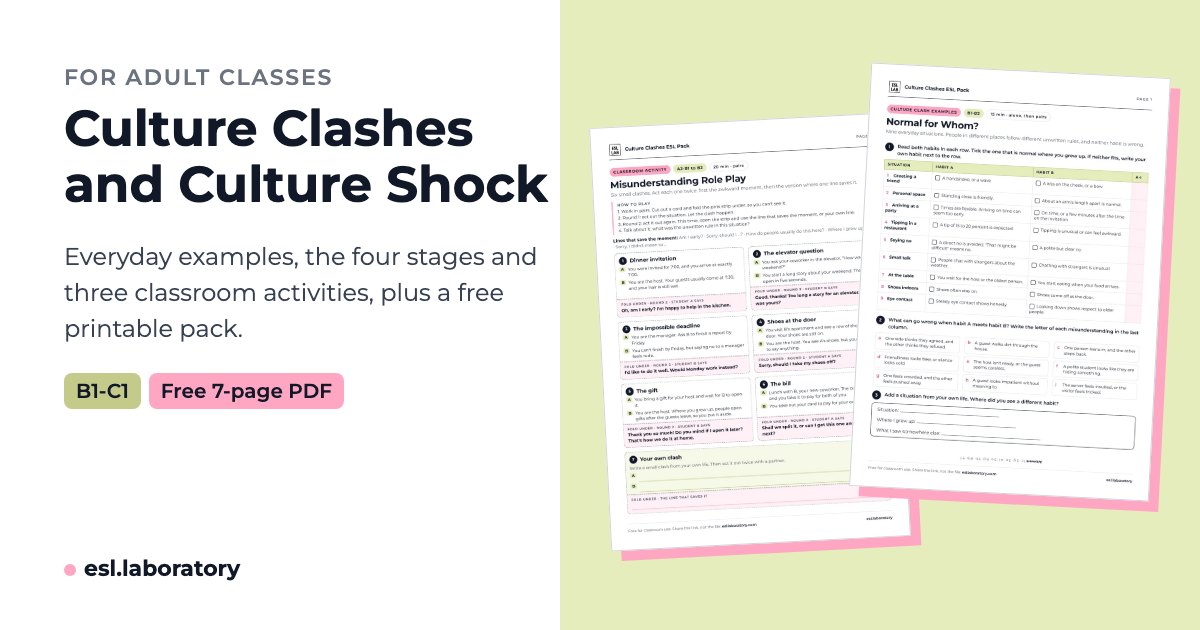
Table of Contents
- What Culture Clashes Are
- Culture Clash Examples From Everyday Life
- Stages of Culture Shock
- Culture Shock Examples Students Can Relate To
- Reverse Culture Shock
- Culture Shock Lesson Plan for ESL Classes
- Discussion Questions About Culture Clashes
- Questions About Personal Experience
- Questions About Views and Opinions
- Classroom Activities on Cultural Differences
- Misunderstanding Role Play
- Rules of My Country
- Etiquette Comparison
- Lessons That Prepare Students for Culture Shock
- Culture Clashes FAQ
Your student grew up where friends greet each other with a kiss on the cheek. On her first day at a new job abroad, she leans in to greet a coworker, and he steps back. Neither of them did anything wrong, yet both walk away feeling awkward. Moments like this are culture clashes, and they make one of the best speaking topics for an adult class.
This article explains culture clashes and culture shock in plain language, with everyday examples and the four stages of culture shock. Then it walks you through a ready Culture Shock lesson and gives you discussion questions and three activities for B1 to C1. Everything students need on paper is in one free PDF. For more lessons on the topic, see the culture section.
Free · printable PDF · no sign-up Culture Clashes ESL Pack Seven pages, in the order of this post. Every page has its instructions printed on it, so students can work alone or in pairs. Pages 1 to 3 have their answers upside down at the bottom.
Download the free PDFUS Letter B1 to C1, with A2-B1 frames on pages 5 to 7 · A4 and US Letter |
What Culture Clashes Are
A culture clash happens when people from different cultures meet and their unwritten rules don't match. So what is culture clash in plain terms? It's the moment one person does something completely normal at home, and the other person reads it as rude, cold or strange. In everyday English, the culture clash meaning is usually about small things, like how close to stand, when to arrive or how directly to say no.
Culture shock is different. A culture clash is one moment between two people. Culture shock is what you feel when you live inside a new culture for weeks or months and those moments keep adding up. One is an event, and the other is a process.
In one line Culture clash: one moment, two people, two sets of unwritten rules. |
Both come from cultural norms, the rules a group follows without thinking about them. Most of us don't notice our own norms until we see them broken. That is why the topic works so well in class. Every adult has a story, and nobody needs special vocabulary to start telling it.
Culture Clash Examples From Everyday Life
The culture clash examples below compare a common norm in the US with a norm found in many other places. Ask students which column feels normal to them and where they have seen the other one.
GreetingIn the USA handshake, or a wave between friendsCommon elsewhereA kiss on the cheek, or a bowOne person leans in, the other steps backPersonal spaceIn the USAbout an arm's length in conversationCommon elsewhereStanding closer is friendlyOne feels crowded, the other feels pushed awayPunctualityIn the USOn time for work, a little late for a partyCommon elsewhereTimes are flexible, and arriving on time can seem too earlyThe host isn't ready, or the guest seems carelessTippingIn the US15 to 20 percent in restaurants is expectedCommon elsewhereTipping is unusual or can feel awkwardThe server feels insulted, or the visitor feels trickedDirectnessIn the USA polite but clear noCommon elsewhereA direct no is avoided, and "that might be difficult" means noOne side thinks they agreed, the other thinks they refusedSmall talkIn the USChatting with strangers about the weatherCommon elsewhereChatting with strangers is unusualFriendliness looks fake, or silence looks coldAt the tableIn the USYou start eating when your food arrivesCommon elsewhereYou wait for the host or the oldest personA guest looks impatient without meaning toShoes indoorsIn the USShoes often stay onCommon elsewhereShoes come off at the doorA guest walks dirt through the houseEye contactIn the USSteady eye contact shows honestyCommon elsewhereLooking down shows respect to older peopleA polite student looks evasive to the teacher
These cultural differences examples are patterns, not rules every person follows. Etiquette changes between cities, generations and families, and students will gladly tell you where the table is wrong about them.
| Free printable · page 1 · Normal for Whom? 1. Greeting a friendA handshake, or a wave + seven more situations, nine misunderstandings to match and a row for the student's own example On the page, the two habits in each row are labeled A and B, not by country, and they swap sides from row to row. Students tick the one they grew up with, then match each row to what can go wrong. |
Work has its own clashes around feedback and hierarchy, which the B2-C1 lesson Doing Business Across Cultures covers in detail.
When the clash happens at work A jigsaw reading on feedback, hierarchy and silence in meetings, followed by role plays where students look for a compromise. |
These differences don't stay outside the classroom. They shape how your students speak English, often without anyone noticing. A student who learned that a direct no is rude may answer "maybe" to a coworker and then never do the task. A student raised to look down when speaking to older people can seem uninterested in a job interview. A learner from a place where small talk is rare may answer "How are you?" with one word and come across as cold. The grammar is correct every time, and the message still goes wrong.
You can help in four ways:
- Name the norm. When an answer sounds abrupt, explain how it lands with English speakers and what they usually expect, instead of only correcting the words.
- Teach softeners and repair phrases. Expressions like I'm afraid that won't work, Sorry, I didn't catch that and How do people usually do this here? give students a safe way through an awkward moment. The A2-B1 lesson Come again? practices exactly these clarifying questions.
- Practice both versions. Let students say no directly and indirectly, then talk about when each one fits. Nobody has to change their values, only add options.
- Ask before you correct. If a habit looks rude, ask students what the same situation looks like at home. Their answer usually explains the mistake.
| Free printable · page 2 · Say It Two Ways Make it softerNo. I can't finish it by Friday.Your plan won't work.What does it usually mean?"That might be difficult."a. It's possible with a bit more work. + a box of softeners and repair phrases, six more lines and three more tick-a-or-b items, with sample answers Students rewrite eight direct lines in a softer way, then go the other way round and decide what four soft lines usually mean. The last task asks when the direct version is the better choice, so nobody learns that direct is wrong. |
Lessons for the same moments Come again? practices clarifying questions with video and role play. In Saying No (B1-B2), students hear a project manager refuse a client politely and practice the same strategies. |
Stages of Culture Shock
The best-known description of the stages of culture shock has four steps. It grew out of the work of anthropologist Kalervo Oberg, who described culture shock in the 1950s, and it is a popular model, not a proven law. Many people skip stages, repeat them or go through them in a different order. Still, students who have lived abroad recognize themselves in it at once. On the board, draw it as a line that starts high, drops, then slowly climbs again, and ask students to mark where they were after one month in a new place.
- The honeymoon stage. Everything is new and exciting, and even the supermarket feels like an adventure. A typical thing to say: "I love it here. Everything is so interesting!"
- Frustration. Small differences start to hurt. Opening a bank account takes all day, jokes are hard to follow, and homesickness sets in. "Why does everything have to be so complicated here?"
- Adjustment. Routines form. You learn how things work, make a few friends and start to laugh at your mistakes. "OK, I'm starting to understand how things work."
- Acceptance. The new culture feels like a second home. The differences are still there, but they no longer cause stress. "I don't love everything here, but this is my life now, and I like it."
The typical phrases are useful in class, too. Read them aloud in random order and let students guess the stage. It is a quick check that they understood the model, and it gives them language for describing their own experience.
Culture Shock Examples Students Can Relate To
These short stories were written for this lesson. Read one aloud and ask which stage the speaker is in. They make good culture shock examples because each one is small and specific.
- "In my first week, a cashier asked me how I was, and I told her about my headache. She looked confused. Later I learned it's just a greeting."
- "Everyone here eats dinner at six. At home we eat at nine, so for a month I was hungry every night at bedtime."
- "My classmates said, 'Let's grab coffee sometime,' and I waited for the invitation. It never came. It was just a friendly way to end the conversation."
- "The first time I paid for lunch, the price on the menu wasn't the price on the bill. Nobody had told me about sales tax."
- "In a meeting, my manager asked what I thought of her plan. At home, I would never disagree with a manager in front of others, so I said it was perfect."
- "After four months, I realized I didn't need a map to get home. That was the day the city started to feel like mine."
| Free printable · page 3 · The Culture Shock Curve 1 Honeymoon2 Frustration3 Adjustment4 Acceptance I love it here. Everything is so interesting!My classmates said, "Let's grab coffee sometime," and I waited for the invitation. It never came. + the curve, eight more quotes and a frame for the student's own first month; suggested answers printed upside down The four stage phrases and the six stories are mixed together on one page, under the curve. Students match each quote to a stage on their own, and some quotes fit two stages, which starts the discussion. |
Easter Shock (B1-B2) shows the same stages through one holiday: a British exchange student's blog about Easter in Norway, a celebration students already know, seen from the outside.
Reverse Culture Shock
Reverse culture shock is the surprise of coming home and finding that home feels foreign. Expats and students change abroad more than they notice, and life at home has moved on without them. Here are two examples. A student returns after a year abroad and finds conversations with old friends slow and predictable. An engineer comes back from three years overseas and suddenly notices how loudly people talk on the bus. Students rarely expect it, which is why it can hit harder than the original culture shock. It helps to talk about it before a trip, not only after. For lessons about moving and living abroad, see the travel section.
Talk, no paper No printing. Ask students who have lived abroad to draw their own curve for the return home, and compare it with the one on page 3. For students about to travel, Responsible Traveller (B2-C1) looks at the same awareness from the visitor's side: how to travel without becoming the tourist locals don't want. |
Culture Shock Lesson Plan for ESL Classes
If you want a full culture shock lesson plan rather than separate activities, our B1-B2 lesson Culture Shock is built on real experience instead of theory. Students watch newcomers to South Korea describe the things that surprised them most, then compare daily life there with life in Europe and talk about what they would find hardest. The second half turns to language. Students look at mistakes non-native speakers make in English, including false friends, words that look familiar but mean something else. That link matters, because culture shock and language shock usually arrive together.
The lesson runs 60 minutes and comes with a Student's and a Teacher's Version, homework and a Quizlet set. On the Pro plan, it also has a Miro board, interactive homework and a revision game.
The full lesson Video, a Student's and a Teacher's Version, homework and a Quizlet set. The free pack's curve on page 3 works as its warm-up. |
Culture shock touches more than one skill, so other lessons in the library prepare students for it from different sides. You'll find them in the table at the end of this post.
Discussion Questions About Culture Clashes
Choose six to eight questions per class. They stay with everyday life on purpose, so students can talk about their own experience without feeling exposed.
Questions About Personal Experience
- Have you ever done something abroad that was normal at home but strange there?
- What surprised you most in the first foreign country you visited?
- Has a visitor ever misunderstood a custom in your country? What happened?
- Which part of your daily routine would surprise a person from another culture?
- Have you ever felt homesick? What helped?
- Is there a rule about eating that everyone in your family follows?
- Have you ever been confused by a gesture or by body language?
- How do you greet a friend, and how do you greet your boss?
- Have you ever lived away from home? Which stage of culture shock did you reach?
- What would you tell a visitor to your city before their first week?
Questions About Views and Opinions
- Should visitors follow every local custom, or should locals make allowances for them?
- Should restaurants include the tip in the price?
- Is small talk with strangers friendly or a waste of time?
- What helps more in a new country, the language or local friends?
- Can you fully understand a culture without living in it?
- Do culture clashes happen more or less often now that so many people work online?
- Should companies train employees before sending them abroad?
- Is being direct honest or rude?
- Which custom from another culture would you like to bring into your own?
- Are some culture clashes funny once they are over? Why do we laugh at them later?
| Free printable · page 4 · Culture Clash Question Cards Your experience · 1Have you ever done something abroad that was normal at home but strange there?Your opinion · 18Is being direct honest or rude? + 18 more cut-out cards and five follow-up questions All 20 questions as cut-out cards, experience cards in pink and opinion cards in green, so groups can start with the easy pile. |
If your students freeze after the first answer, The Art of Small Talk (A2-B1) practices starting, keeping and ending a conversation, the skill newcomers often find hardest.
Classroom Activities on Cultural Differences
Each activity below comes with ready examples, so you can copy them onto cards or the board and start straight away. All three are printed in the free pack.
Misunderstanding Role Play
1of 3A2-B1 to B220 minPairsFree printable · page 5 Misunderstanding Role Play Pairs get a situation card and act it out twice. The first time, the clash happens. The second time, one of them uses a line that saves the moment. Students practice asking about norms and apologizing, which is exactly the language they need abroad. Here are four cards to start with. Page 5 adds two more, the gift and the bill, and an empty card for a clash from the students' own lives.
For twelve more everyday role plays with printable cards, see our post on ESL role play scenarios for adults.
|
Rules of My Country
2of 3A2-B1 to B220 minAlone, then groupsFree printable · page 6 Rules of My Country Each student writes five unwritten rules for a visitor to their country or city. Groups compare lists and look for rules that surprise them. In a mixed group, this becomes real cultural exchange. In a group from one country, students often disagree about their own rules, which is just as useful. Show these sample rules first so students see what "unwritten" means:
|
Etiquette Comparison
3of 3A2-B1 to B225 minGroupsFree printable · page 7 Etiquette Comparison Each group takes one topic, such as gifts, dinner or business meetings, and compares the etiquette in two countries its members know. They present three similarities and three differences, and the class challenges any point that sounds like a stereotype. For gifts, a group might report the model below. With A2-B1 groups, give them the short frame for comparing.
|
Culture Clashes ESL Pack All seven printables from this post in one free PDF: the habits table, the softeners, the curve, 20 question cards, the role-play cards, the rules page and the comparison frame. |
Lessons That Prepare Students for Culture Shock
Each lesson below comes with a Student's and a Teacher's Version and a Quizlet set. All of them are part of the subscription.
| Lesson | Level | How it helps with culture shock |
| East Meets West | A2-B1 | Students compare everyday habits through designer Yang Liu's illustrations and practice comparatives to describe differences without judging them |
| British Etiquette | A2-B1 | A video on three common etiquette rules gives students the phrases for manners and shows that unwritten rules can be learned |
| The Art of Small Talk | A2-B1 | Students practice starting, keeping and ending casual conversations, the skill newcomers often find hardest |
| Come again? | A2-B1 | Clarifying questions like Sorry, I didn't catch that help students recover when a conversation breaks down |
| Culture Shock | B1-B2 | Newcomers to South Korea describe their surprises on video, and students compare daily life and look at false friends |
| Saying No | B1-B2 | A podcast episode shows a project manager refusing a client politely, and students practice the same strategies |
| Easter Shock | B1-B2 | A British exchange student's blog about Easter in Norway shows culture shock around a holiday students know |
| Doing Business Across Cultures | B2-C1 | A jigsaw reading on feedback, hierarchy and silence in meetings, followed by role plays that look for a compromise |
| Responsible Traveller | B2-C1 | Students discuss socially and culturally aware travel and how not to be the visitor locals don't want |
Culture Clashes FAQ
How do I talk about cultural differences without stereotypes?
Present differences as norms that many people in a place share, never as traits every person has. Phrases like "in many families" and "people often" help. Invite students to correct you about their own culture, because that conversation is often the best part of the lesson.
What level is this topic for?
It works from B1. A2 students can share simple examples, but explaining why norms differ needs B1 language. At C1, the reverse culture shock section and the opinion questions give enough depth.
How do I teach it in a mixed group?
A mixed group is ideal. Let students be the experts on their own countries, keep the focus on everyday customs, and pair students from different backgrounds for the role play.
How long does culture shock last?
There is no fixed timeline. For many people, frustration arrives a few weeks or months after the move, and adjustment takes longer. Some people move through the stages quickly, and some stay in one stage for a long time.
Do I need to sign up to download the PDF?
No. The Culture Clashes ESL Pack is a direct download, in A4 and US Letter.
The full Culture Shock lesson, with video, worksheets and a Teacher's Version, comes with the teacher subscription.